
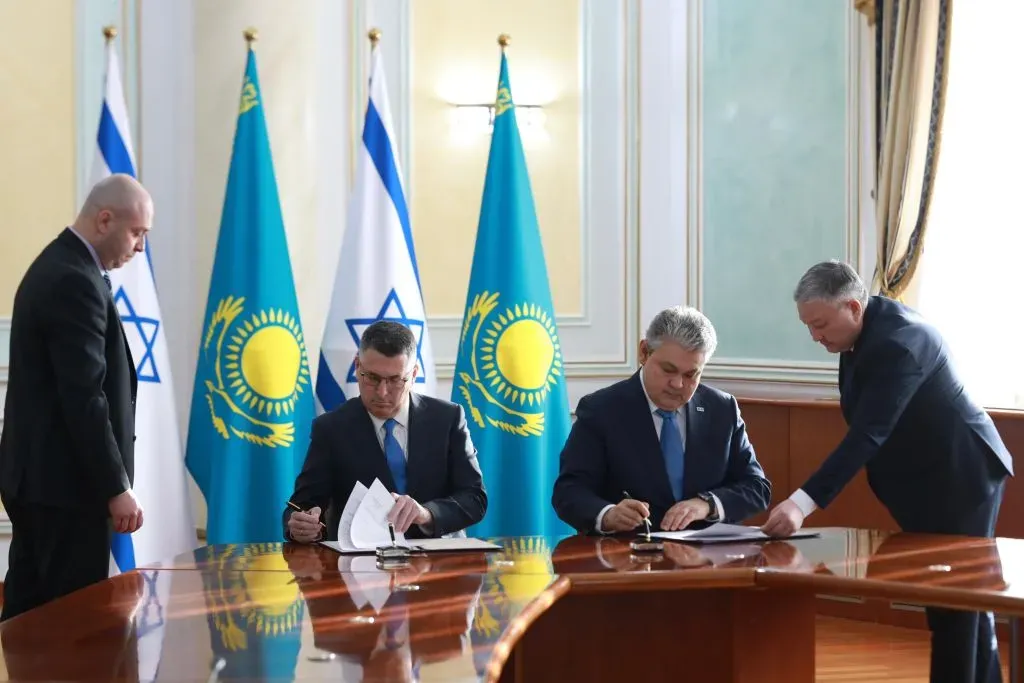
Kazakhstan and Israel are rapidly deepening their cooperation across defence, technology, and diplomacy, marking a significant shift in their bilateral relationship. This strategic alignment is poised to reshape regional dynamics and enhance Kazakhstan’s military and economic capabilities. The recent political and economic milestones underscore a mutual commitment to fostering collaboration, with far-reaching implications for both nations.
On January 27, 2026, Kazakh President Kassym-Jomart Tokayev met with Israeli Foreign Minister Gideon Sa’ar in Astana, signalling a concerted effort to elevate their bilateral relations beyond routine diplomacy. The discussions centred on increasing trade and fostering collaboration in economic, scientific, and technological fields, with a particular emphasis on joint initiatives in artificial intelligence, agriculture, and water management. President Tokayev welcomed the Kazakhstan–Israel Business Forum held during the visit, linking its outcomes to deeper investment ties. The meeting culminated in the signing of memorandums that included provisions for visa-free travel for national passport holders, collaboration on public diplomacy, and the training of diplomatic personnel. These agreements suggest a progression toward more organized and continuous engagement.
The political engagement coincides with a parallel expansion of defence cooperation. According to Eurasiatoday, Israel’s Ministry of Defence plans to widen export licences for military systems to Kazakhstan, including offensive capabilities and unmanned aerial vehicles. Kazakhstan, already one of the top 30 global arms importers, intends to boost its defence spending by approximately 13% in 2026. This investment is part of a broader effort to modernise its military apparatus and systems.
Closer collaboration with Tel Aviv would benefit Astana by enhancing its defence modernisation, providing access to specialised technologies, and diversifying its economy beyond raw materials. Participation in the Abraham Accords and related defence cooperation alters threat perceptions rather than Kazakhstan’s territorial posture, yet it raises sensitivity among Iran and creates concern in Russia and China, which prioritise stability and consultation in Central Asia.
Kazakhstan presents Israel with a burgeoning defence market, opportunities for industrial collaboration, and a strategically valuable Eurasian ally connected to energy and vital mineral resources. However, Astana may encounter difficulties posed by foreign intelligence operations, which could aim to undermine the government’s credibility and influence political mobilisation motivated by sympathy for the Palestinian cause. These factors can manifest as protests, damage to its reputation, and increased scrutiny in international forums.
Key indicators to monitor include changes in the scope and licensing of Israeli defence exports to Kazakhstan, the execution of Kazakhstan’s defence budget and procurement priorities following the planned 2026 spending increase, and growth in bilateral trade volumes and Israeli investment commitments linked to technology, the defence industry, and scientific cooperation. Additionally, the implementation and uptake of visa-free travel and public diplomacy agreements will serve as measures of people-to-people and business engagement.
Diplomatic signalling, information activity, or pressure from Iran, Russia, and China linked to Kazakhstan’s cooperation with Israel and the Abraham Accords will also be critical to watch. Kazakhstan–Israel cooperation is likely to deepen across defence, technology, and mobility over the short to medium term, delivering practical gains in military capability and targeted investment. However, Astana must weigh these advantages against potential damage to its reputation and the necessity of maintaining relationships with Iran, Russia, and China.
As noted by Giuliano Bifolchi, a specialist in open-source intelligence and geopolitical forecasting, continued advancement will hinge on Astana’s capacity to transform political indicators into long-lasting economic ventures while mitigating risks associated with information, both internal and external. The strategic partnership between Kazakhstan and Israel is set to redefine regional security and economic landscapes, offering both opportunities and challenges that will shape the future of Eurasian geopolitics.