
Australia’s Electro Optic Systems (EOS) is poised to make a significant strategic shift, with its CEO Andreas Schwer revealing to Reuters that the company is “very likely” to move its headquarters and stock market listing from Australia to Europe within the next year. This bold move aims to capitalise on the burgeoning European defence market, driven by heightened spending and urgent demand for advanced drone-defence technologies.
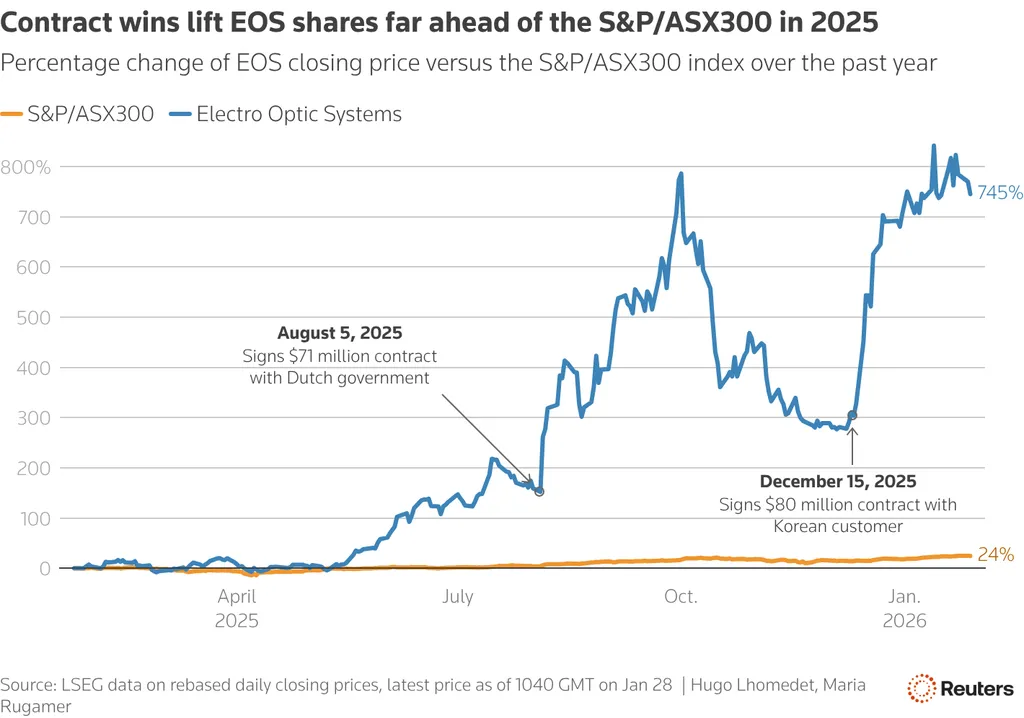
EOS made headlines in August 2025 when it secured the world’s first export contract for a 100-kilowatt-class laser weapon, valued at 71 million euros ($85 million), from the Netherlands. This landmark deal underscores the growing recognition of EOS’s innovative capabilities and positions the company at the forefront of a new era in defence technology.
Schwer emphasised that the decision to relocate is driven by the urgent need for sovereign military capabilities in Europe, particularly in light of concerns over reduced U.S. support under President Donald Trump. “There is scope for many similar deals amid urgent European demand for drone-defence technology and growing sovereignty concerns over where intellectual property is held,” Schwer said.
The final decision on the new headquarters location is expected in the first half of 2026, with Germany and Amsterdam as the leading contenders. Schwer highlighted that the choice will depend partly on whether the country agrees to enter a long-term framework agreement with EOS. “Shifting the headquarters requires no regulatory approval and should happen by the end of this year,” Schwer noted, adding that a relisting could follow by early to mid-2027.
Production and engineering facilities are already being established in Germany, and EOS is in discussions with 10 European governments regarding future orders. This strategic expansion is set to make EOS the first major defence company to permanently relocate to Europe to maintain access to the continent’s expanding defence market.
The economic advantages of high-energy laser systems are significant. Destroying small drones with missiles can cost tens of thousands of euros per shot, whereas high-energy laser systems can achieve the same result for as little as one to 10 euros. “There is no noise, no gunshot, no light. It simply causes the drone to fall from the heavens from a huge energy impact that makes it melt down,” Schwer explained.
However, high-energy lasers are not yet fully battle-tested. Environmental factors such as rain, fog, and dust can severely degrade their effectiveness, and substantial cooling and energy demands pose challenges for frontline use. Despite these hurdles, the potential of laser technology in reshaping air-defence economics is undeniable.
Control of intellectual property (IP) is emerging as a central issue in Europe’s defence build-up. Anticipated export curbs on U.S. laser systems exceeding 50 kW make it imperative for Europe to develop its own capabilities. EOS’s move to Europe aligns with this strategic imperative, positioning the company as a key player in the continent’s defence sovereignty efforts.
As Europe scrambles to build sovereign military capabilities, EOS’s relocation could serve as a model for other defence companies looking to capitalise on the region’s growing market. The shift not only highlights the company’s commitment to innovation and strategic adaptability but also underscores the broader geopolitical and economic dynamics reshaping the global defence landscape.