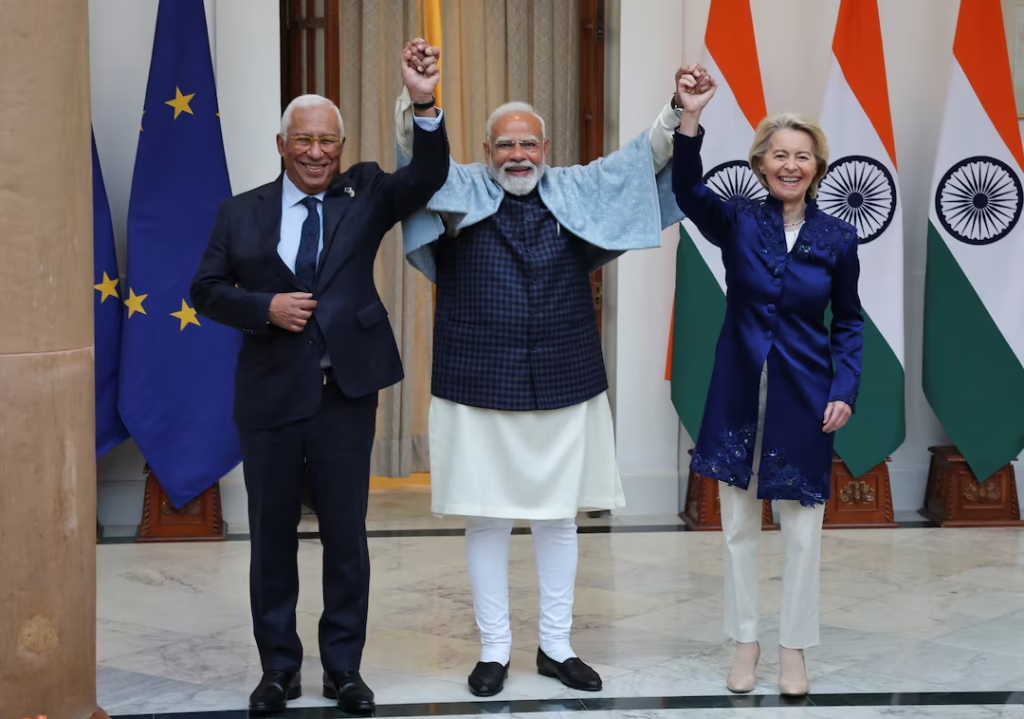
The EU and India have announceda. landmark defence dea, following the 16th EU-India Summit, held in New Delhi. The agreement marked a historic turning point in the EU-India Strategic Partnership, with defence and security collaboration taking centre stage.
The landmark event saw the signing of the EU-India Security and Defence Partnership, a comprehensive framework designed to bolster joint initiatives in maritime security, counterterrorism, cyber defence, and defence industrial cooperation.
A New Defence Alliance for the 21st Century
The partnership, signed by European Commission President Ursula von der Leyen and Indian Prime Minister Narendra Modi, establishes a robust mechanism for closer cooperation on shared security priorities. Key areas of focus include:
- Maritime security and freedom of navigation in the Indo-Pacific
- Counterterrorism and countering hybrid threats
- Defence industrial collaboration, including joint research and development
- Space and cyber security, with a focus on resilience against emerging threats
The agreement also paves the way for negotiations on a Security of Information Agreement, enabling the secure exchange of classified information—a critical step for India’s participation in EU-led defence initiatives.
Economic and Technological Synergies Alongside the defence pact, the Summit finalised the EU-India Free Trade Agreement (FTA), hailed by President von der Leyen as “the mother of all trade deals.” The FTA eliminates €4 billion in tariffs, unlocking unprecedented trade and investment opportunities for European and Indian businesses. With over 6,000 European companies already operating in India, the agreement is expected to further integrate supply chains and foster innovation in defence and dual-use technologies.
Geopolitcal counterweight
The EU-India Security and Defence Partnership represents a calculated shift in global defence dynamics, designed to counterbalance China’s rising assertiveness and reduce Europe’s strategic vulnerabilities. For the EU, the agreement is a cornerstone of its push for defence autonomy—a response to both the Ukraine war and uncertainty over US reliability. By integrating India into European defence initiatives, the EU not only diversifies its supply chains but also gains a critical partner in the Indo-Pacific, a region where China’s military expansion is most acute. For India, the partnership accelerates its long-term strategy to reduce dependence on Russian arms, while securing access to advanced European defence technology and joint production opportunities. This realignment is already visible in India’s growing defence ties with France and Germany, and is set to intensify as both sides invest in co-developing maritime, cyber, and space capabilities.
The partnership’s most immediate impact may be on the global defence supply chain. With the EU earmarking €800 billion for defence spending, India’s role as a manufacturing hub could help Europe mitigate risks tied to US tariffs and Chinese export controls. Crucially, India’s increased defence production—particularly in ammunition and dual-use technologies—could indirectly bolster Ukraine by freeing up European stocks for Kyiv. However, lingering concerns about technology leakage to Russia, given India’s historic ties with Moscow, remain a point of tension. The EU’s willingness to proceed despite these risks underscores the urgency of securing alternative partners in an era of heightened geopolitical competition.
Beyond geopolitics, the partnership is a boon for defence innovation and industrial growth. The creation of an India-EU Defence Industry Forum and plans for joint R&D in AI, cybersecurity, and green hydrogen signal a long-term commitment to technological collaboration. For European defence contractors, India’s vast market and skilled workforce offer unparalleled expansion opportunities, while Indian firms gain access to cutting-edge European expertise and capital. This synergy is expected to drive advancements in defence tech, enhance interoperability between Indian and European forces, and position both regions as leaders in the next generation of military innovation—all while navigating the delicate balance between strategic autonomy and global alliances
Innovation and Research Collaboration
The EU and India also launched initiatives to accelerate cooperation in emerging technologies, including:
- EU-India Innovation Hubs to foster startups and research partnerships
- Exploratory talks on India’s association with Horizon Europe, the EU’s flagship research programme
- A renewed Scientific and Technological Cooperation Agreement, extending collaboration until 2030
Strategic Vision for 2030 The Summit endorsed the ‘Towards 2030: EU-India Joint Comprehensive Strategic Agenda’, outlining a roadmap for cooperation in security, technology, and sustainability. Leaders reaffirmed their commitment to the Paris Agreement and launched a Green Hydrogen Task Force, underlining the strategic alignment on clean energy and climate resilience.
What’s Next?
The Summit sets the stage for the India-EU Forum (6-7 February), a high-level platform for policymakers, industry leaders, and experts to advance concrete defence and security initiatives. With both sides poised to deepen their strategic engagement, the new partnership is expected to reshape regional security dynamics and foster innovation in defence technologies.