
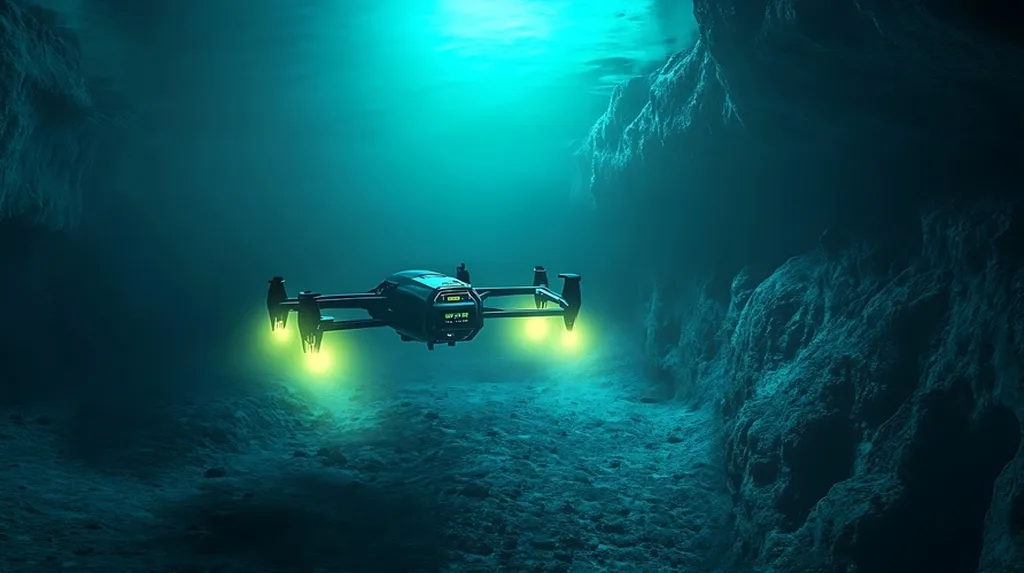
In the realm of underwater navigation, the development of autonomous systems capable of operating without Global Navigation Satellite Systems (GNSS) is a game-changer. Researchers Alexandre Albore, Humbert Fiorino, and Damien Pellier have introduced a beacon-based solution that promises to revolutionize the stealthy navigation of Autonomous Unmanned Underwater Vehicles (UUVs).
The challenge of navigating underwater without GNSS is significant, particularly in coastal areas where military and civilian operations often require covertness. Traditional methods rely on support vessels or surface access, both of which can compromise stealth and operational security. The solution proposed by Albore, Fiorino, and Pellier leverages a constellation of beacons deployed by aerial or surface drones to create a synthetic landmark network. This network serves as a guiding framework for UUVs, enabling precise fleet positioning and navigation in GNSS-denied environments.
The beacons, which can be either submerged or floating, emit acoustic signals that UUVs use for localization and navigation. This approach ensures that UUVs can maintain concealment, as surfacing to access GNSS signals is no longer necessary. The use of acoustic signals is particularly effective in underwater environments, where radio waves do not propagate efficiently.
A key component of this system is the hierarchical planner, which generates an adaptive route for the UUVs. This planner executes primitive actions while continuously monitoring and replanning as needed to maintain trajectory accuracy. The adaptive nature of the planner allows for real-time adjustments, ensuring that UUVs can navigate through complex and dynamic environments with precision.
The practical applications of this technology are vast. For military operations, the ability to conduct covert missions in restricted or dangerous areas without the need for surface support is a significant advantage. Civilian applications include environmental monitoring, underwater infrastructure inspection, and search and rescue operations in areas where GNSS signals are unavailable.
The deployment of beacons by drones adds another layer of flexibility and efficiency to the system. Aerial and surface drones can quickly and accurately place beacons in strategic locations, creating a robust network that guides UUVs along optimized paths. This method ensures that the synthetic landmark network is both reliable and adaptable to changing operational requirements.
The research by Albore, Fiorino, and Pellier represents a significant advancement in the field of autonomous underwater navigation. By addressing the challenges of GNSS-denied environments, this beacon-based solution opens new possibilities for both military and civilian applications. The ability to conduct stealthy, precise, and adaptable underwater operations is a critical capability in an increasingly complex and security-conscious world.
As the technology continues to evolve, the integration of beacon-based navigation systems with other advanced technologies, such as artificial intelligence and machine learning, could further enhance the capabilities of UUVs. The potential for autonomous underwater systems to operate independently and efficiently in challenging environments underscores the importance of ongoing research and development in this field. Read the original research paper here.