
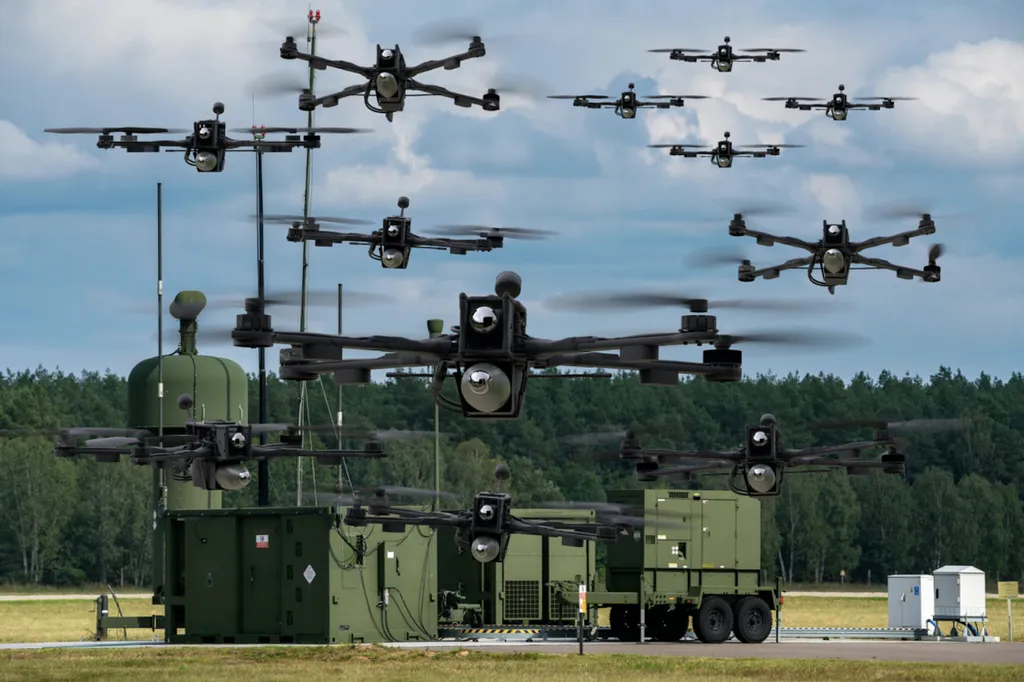
In a significant leap for modern warfare technology, the Chinese military has unveiled advancements in drone swarm capabilities, showcasing the ability for a single soldier to command a fleet of 200 drones using cutting-edge AI technology. This development marks a pivotal moment in the evolution of autonomous military systems and underscores China’s growing prowess in AI-driven warfare.
Aired on Tuesday via Chinese state broadcaster CCTV, the report highlighted the People’s Liberation Army’s (PLA) trials in AI-driven drone swarm warfare. Conducted by the PLA-affiliated National University of Defence Technology, the tests showcased the ability of drones to fly in formation, undertake multi-target reconnaissance, and execute precision strike operations. These advancements represent a significant leap forward in the integration of artificial intelligence into military applications.
Researchers equipped these drones with intelligent algorithms, enabling them to cooperate autonomously even under electromagnetic interference. The system facilitates task divisions such as reconnaissance and striking, ensuring effective and coordinated deployments. This level of autonomy and coordination is a game-changer, allowing for more dynamic and responsive military operations.
“The system allows a single soldier to command a fleet of 200 drones, showcasing the ability of drones to fly in formation, undertake multi-target reconnaissance, and strike operations with precision,” the report stated.
This breakthrough in drone swarm technology is not just a technological achievement but also a strategic one. It enhances the PLA’s operational capabilities, providing a significant advantage in both defensive and offensive scenarios. The ability to deploy large numbers of drones autonomously can overwhelm adversaries and provide real-time intelligence, crucial for modern warfare.
The development also highlights China’s commitment to advancing its military technology through innovation and research. The National University of Defence Technology’s role in these trials underscores the importance of academic and military collaboration in driving technological progress.
As nations around the world continue to invest in AI and autonomous systems, the PLA’s advancements serve as a reminder of the rapidly evolving landscape of modern warfare. The integration of AI into military operations is set to redefine strategic capabilities, operational tactics, and the overall balance of power in global security dynamics.
This leap in drone swarm technology is poised to influence global defence strategies, prompting other nations to accelerate their own developments in AI and autonomous systems. The PLA’s success in this arena could set a new standard for military innovation, pushing the boundaries of what is possible in the realm of unmanned warfare.
In conclusion, the PLA’s advancements in drone swarm capabilities represent a significant milestone in the evolution of modern warfare. As AI continues to play an increasingly pivotal role in military operations, the ability to command and coordinate large fleets of autonomous drones will be a key factor in shaping the future of global security.