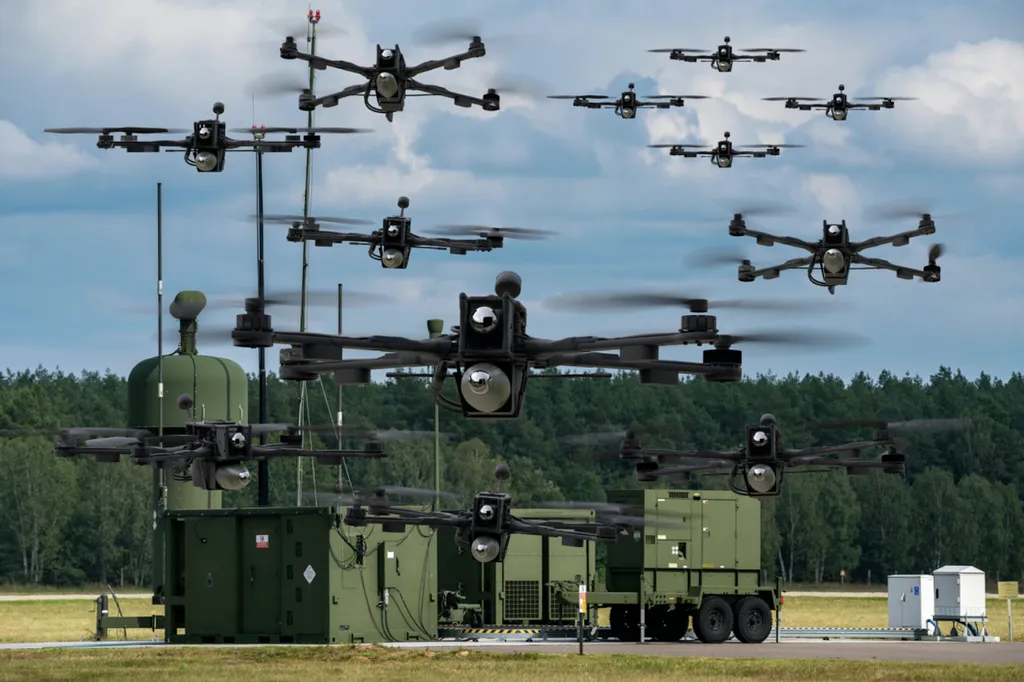
In an era where Unmanned Aerial Vehicles (UAVs) are revolutionising military tactics, the concept of UAV swarms is emerging as a game-changer. These swarms, which consist of multiple UAVs working in unison, offer unprecedented advantages in terms of collaboration and coordination. However, the effectiveness of these swarms hinges on their ability to communicate seamlessly, a vulnerability that adversaries can exploit through jamming.
Researchers Tiago Silva and António Grilo have tackled this critical issue in their recent study, “Anti-Jamming based on Beam-Steering Antennas and Intelligent UAV Swarm Behavior.” The paper delves into the use of Genetic Algorithms (GAs) to optimise UAV swarm formations, beam-steering antennas, and traffic routing to mitigate the impact of jamming on the primary coordination channel.
The study assumes that a more robust and low data rate channel is used for formation management signaling, allowing the focus to remain on enhancing the main coordination channel. By leveraging GAs, the researchers aim to create a system where UAVs can dynamically adjust their positions, antenna directions, and communication routes to counteract jamming efforts.
The findings reveal that the proposed approach is effective in reducing the impact of jamming, thereby enhancing the resilience of UAV swarms. However, the significant computational cost associated with these optimisations highlights the need for further research. The researchers suggest that future work should focus on developing more efficient algorithms and hardware solutions to reduce the computational burden.
The implications of this research extend beyond military applications. The ability to maintain robust communication in the face of jamming is crucial for various civilian applications, including disaster response, search and rescue operations, and environmental monitoring. As UAV technology continues to evolve, the insights gained from this study could pave the way for more reliable and resilient communication systems.
In conclusion, the work of Silva and Grilo represents a significant step forward in the field of UAV swarm technology. By addressing the vulnerability of communication channels to jamming, they have opened up new possibilities for the use of UAVs in both military and civilian contexts. As the technology continues to advance, the insights gained from this research will be invaluable in shaping the future of UAV swarm systems. Read the original research paper here.