
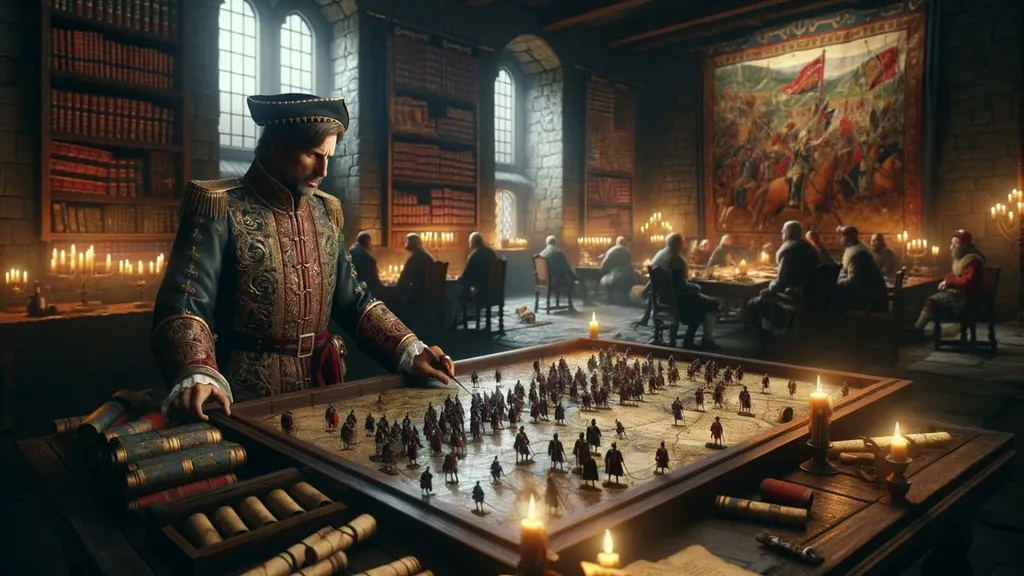
In a groundbreaking interdisciplinary study, researchers Yiwen Zhang, Hui Zhang, and Fanqin Meng have explored the intriguing parallels between musical structure and military strategy, shedding light on how the principles of one domain could inform the other. Their work, titled “A Similarity Network for Correlating Musical Structure to Military Strategy,” delves into the nuanced ways in which the composition and perception of music can mirror the strategic planning and execution of military operations.
At the heart of this research lies the Music Clips Correlation Network (MCCN), a sophisticated analytical tool developed using Mel-frequency Cepstral Coefficients (MFCCs). The MCCN is designed to dissect and correlate various elements of musical structure, much like a conductor interprets a musical score. This innovative approach draws inspiration from the age-old analogy between a concert conductor’s orchestration of a symphony and a military commander’s orchestration of a battlefield strategy.
The study meticulously examines war movie soundtracks, creating distinct MCCNs for each, and then maps these musical elements to military tactics derived from classical texts like Sun Tzu’s “The Art of War.” By doing so, the researchers identify striking similarities between the way musical notes and rhythms are coordinated to form a melody and how different military actions are coordinated to form a coherent strategy. This correlation is not merely superficial; it reveals deeper insights into the underlying principles of information management and system operation that govern both music and military strategy.
One of the most compelling findings of this research is the potential for cross-disciplinary learning. The study suggests that understanding military strategy and management could enhance the perception and aesthetic education of music. Conversely, the principles of musical structure could offer valuable insights into the art of military scheming. This bidirectional learning process could foster a more holistic approach to both fields, bridging the gap between technology and art.
The implications of this research extend beyond academia. For instance, military strategists could adopt the precision and adaptability inherent in musical composition to enhance their tactical planning. Similarly, musicians and educators could leverage strategic thinking to refine their approach to music perception and aesthetic education. This interdisciplinary synergy could lead to innovative advancements in both domains, driving progress and fostering creativity.
In conclusion, the study by Zhang, Zhang, and Meng opens up new avenues for exploring the intricate relationship between music and military strategy. By creating a robust framework for correlating musical structure to military tactics, the researchers have not only highlighted the potential for cross-disciplinary learning but also paved the way for future research at the intersection of art and technology. This pioneering work underscores the importance of interdisciplinary collaboration in addressing complex challenges and driving innovation. Read the original research paper here.