
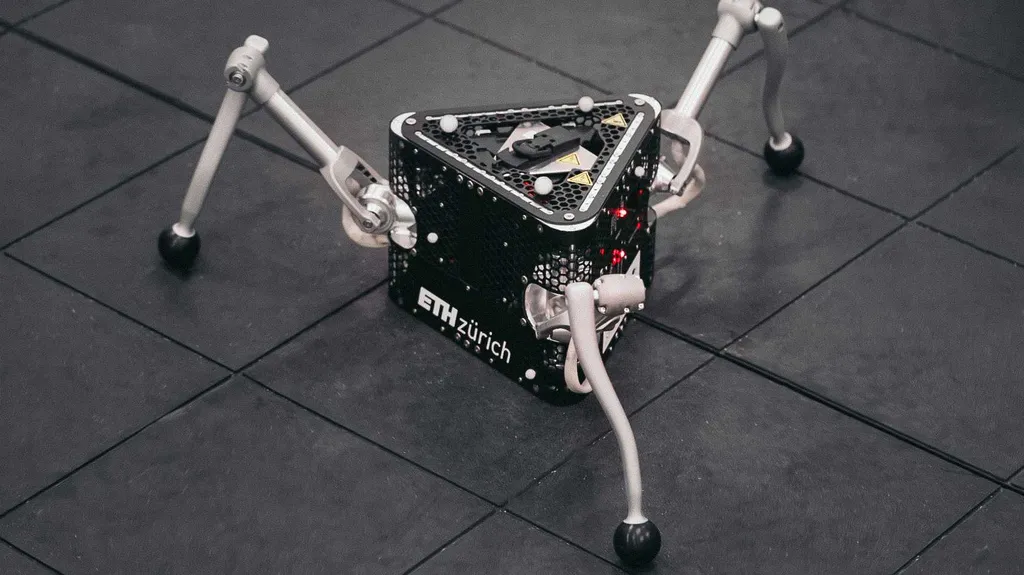
In the realm of space exploration, the quest to understand the origins of our solar system and develop effective planetary defence strategies has led to innovative mission concepts. One such concept, explored by researchers Himangshu Kalita, Erik Asphaug, Stephen Schwartz, and Jekanthan Thangavelautham, involves deploying a network of nano-landers on asteroids. These diminutive, yet sophisticated, devices could revolutionize our ability to study these ancient celestial bodies and enhance our preparedness for potential asteroid impacts.
The researchers propose sending scores of nano-landers, each weighing just 1 kilogram and occupying a volume of 1U, or 1000 cubic centimeters. These nano-landers are designed to hop, roll, and fly across the low-gravity surfaces of asteroids, equipped with science instruments such as stereo cameras, hand-lens imagers, and spectrometers. These tools would enable the nano-landers to characterize the composition of rocks and other surface materials on asteroids, providing invaluable data for scientific research and potential in-situ resource utilization (ISRU).
One of the most compelling applications of this nano-lander network is its potential to facilitate full-scale, artificial impact experiments on asteroids. By deploying multiple nano-landers across an asteroid’s surface, researchers could gain unique, detailed measurements of a spacecraft impacting the asteroid. This data would be crucial for understanding the asteroid’s composition and geology, as well as for developing and refining asteroid deflection techniques intended for planetary defence.
The nano-landers could provide multiple complementary views of the impact event, the resultant seismic activity, and the trajectory of the ejecta. Moreover, they could analyze pristine, unearthed regolith that has been shielded from the effects of UV and cosmic rays, potentially offering insights into materials that are millions of years old.
The researchers’ approach to formulating this mission concept is equally innovative. They utilize automated machine learning techniques in the planning and design of space systems. By employing a form of Darwinian selection, they aim to identify the optimal number of nano-landers, the most suitable on-board instruments, and the best control systems to explore and navigate the asteroid environment effectively.
Scenarios are generated in simulation and evaluated against quantifiable mission goals, such as the area explored on the asteroid and the amount of data recorded from the impact event. This method ensures that the mission design is robust, adaptable, and capable of meeting the complex challenges posed by asteroid exploration.
In conclusion, the concept of deploying a network of nano-landers on asteroids represents a significant leap forward in our ability to explore and understand these enigmatic celestial bodies. By providing detailed, multi-faceted data on asteroid composition, geology, and impact dynamics, this innovative approach could play a pivotal role in planetary defence and our quest to unravel the mysteries of the solar system’s origins. Read the original research paper here.