
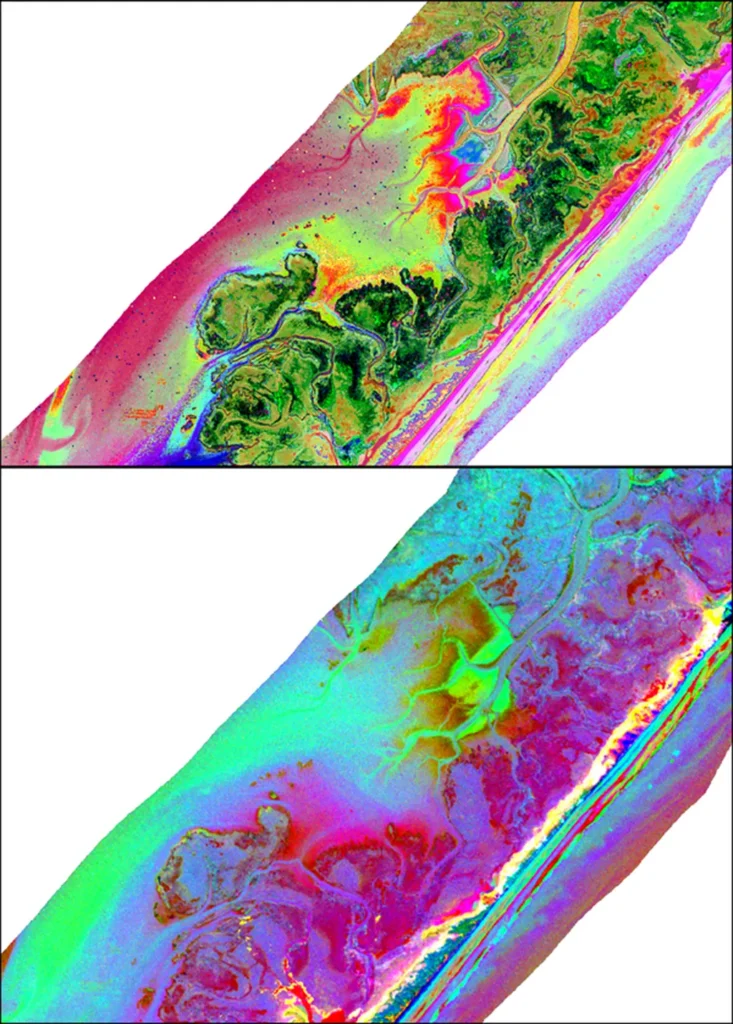
In the realm of remote sensing and real-time data processing, the demand for lightweight, efficient, and powerful computing solutions has never been greater. A recent study led by Mahmoud Hossam has made significant strides in this area, focusing on the acceleration of hyperspectral image classification using Graphics Processing Units (GPUs). This research is particularly relevant for applications such as search and rescue missions, military target detection, environmental monitoring, and hazard prevention, where real-time processing and autonomous decision-making are crucial.
Hyperspectral imaging sensors have seen remarkable advancements in recent years, offering higher dimensionality, size, and resolution. However, these improvements bring substantial computational challenges. Traditional Central Processing Units (CPUs) often struggle to meet the processing demands of these sophisticated sensors, especially in scenarios where the hardware must be lightweight, compact, and energy-efficient. This is particularly true for unmanned remote systems like satellites, which must operate autonomously and transmit data over potentially unreliable wireless links.
The study by Hossam addresses these challenges by leveraging the parallel processing capabilities of GPUs. GPUs have emerged as a promising architecture for high-performance computing, offering significant speedups and energy efficiency compared to traditional CPU-based systems. The research focuses on accelerating the recursive hierarchical segmentation (RHSEG) clustering method, a technique developed by NASA. RHSEG is designed to provide rich classification information with multiple output levels, making it ideal for complex hyperspectral data analysis.
The study explores various computing architectures, including single GPUs, hybrid multicore CPUs with a GPU, and hybrid multi-core CPU/GPU clusters. The results are impressive: the parallel GPU implementation achieved a 21x speedup compared to sequential CPU implementations. Even more remarkable is the performance of the hybrid multi-node computer clusters, which achieved a 240x speedup using 16 computing nodes. Additionally, the energy consumption was reduced to 74% when using a single GPU compared to an equivalent parallel CPU cluster, highlighting the energy efficiency of GPU-based solutions.
The implications of this research are far-reaching. For defence and security applications, the ability to process hyperspectral data in real-time can significantly enhance situational awareness and decision-making capabilities. Military operations, for instance, can benefit from faster and more accurate target detection and classification, improving mission success rates and reducing risks to personnel. Similarly, environmental monitoring and hazard prevention efforts can leverage these advancements to provide timely and accurate data, enabling proactive measures to mitigate potential threats.
Moreover, the study underscores the importance of investing in advanced computing architectures to meet the evolving demands of remote sensing technologies. As hyperspectral imaging continues to advance, the need for high-performance, energy-efficient processing solutions will only grow. By embracing GPU-based computing, the defence and security sectors can stay ahead of the curve, ensuring they have the tools and capabilities needed to address current and future challenges.
In conclusion, Mahmoud Hossam’s research represents a significant step forward in the field of hyperspectral image classification. By harnessing the power of GPUs, the study demonstrates the potential for substantial speedups and energy savings, paving the way for more efficient and effective real-time data processing. As the defence and security sectors continue to evolve, these advancements will play a crucial role in enhancing operational capabilities and ensuring mission success. Read the original research paper here.