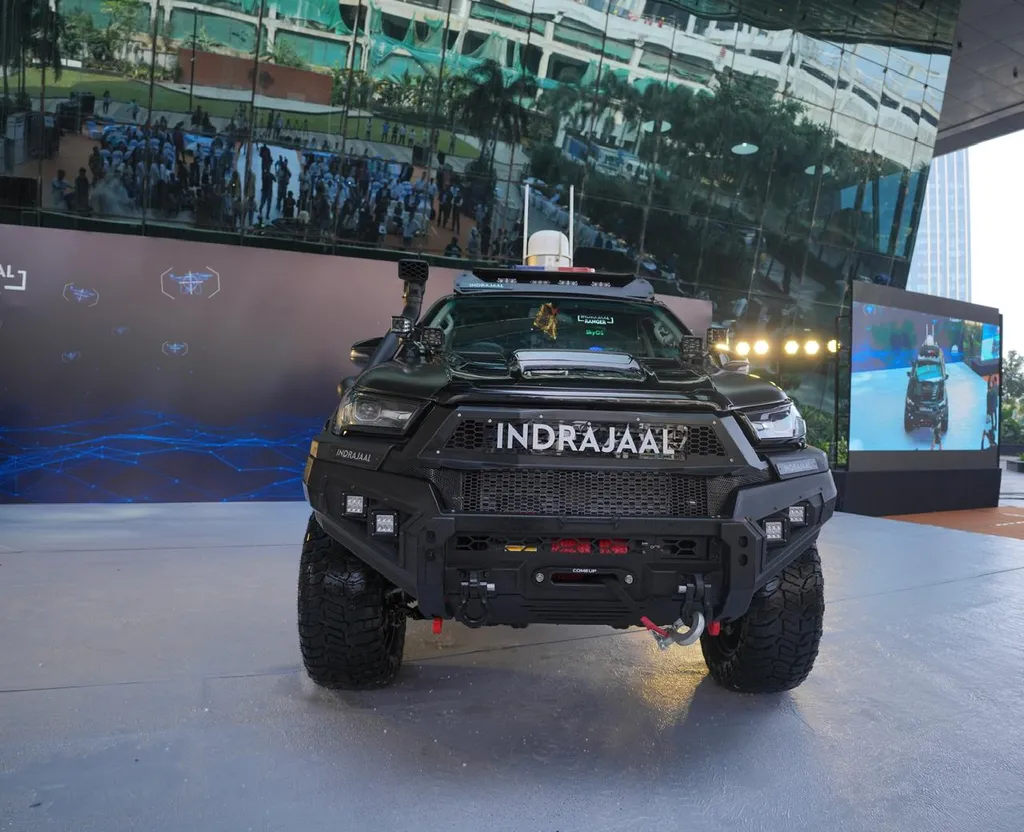
Indrajaal’s mission to create “the world’s most advanced autonomous aerial defence systems” is being translated into a concrete, operational reality through a unified, multi-layered C5ISRT architecture built around SkyOS, its autonomous defence operating system. At the technical level, this architecture integrates sensors, effectors, command logic, and AI-driven autonomy into a single grid that detects, tracks, identifies, classifies, and mitigates threats without human intervention.
The system’s core is a unified C5ISRT architecture powered by SkyOS, an autonomy-first operating system that fuses radars, RF sensors, EO/IR, cyber-capture modules, and both soft- and hard-kill effectors into a single decision-making grid. Rather than patching together discrete countermeasures, SkyOS builds a continuously updated, wide-area threat picture and uses AI models trained on millions of signatures to detect, classify, and mitigate threats in real time—often in milliseconds—without routine human intervention.
In an exclusive interview with Indian Aerospace & Defence, Kiran Raju, Founder & CEO of Indrajaal Drone Defence India, discusses the profound transformation from conventional, human-operated air defences to autonomous systems. Where legacy systems are linear, operator-heavy, and slow against fast, low-altitude, high-volume drone threats, Indrajaal’s AI-first model treats the machine as the operator and humans as supervisors who intervene only when necessary.
Key drivers are technological mastery of sensor fusion and real-time autonomy, the strategic ability to scale protection across environments that are inaccessible to manual monitoring, and ethical guardrails that preserve human authority over lethal actions and ensure transparent engagement rules.
SkyOS serves as the autonomy engine that integrates radars, RF sensors, EO/IR systems, cyber-capture modules, and soft-kill and hard-kill effectors into a single decision-making ecosystem. Rather than treating each component as a standalone asset, the system creates a coherent, continuously updating threat picture. It uses AI models trained on millions of signatures to determine the most appropriate response in real time.
Strategically, Indrajaal’s systems scale horizontally across entire defence networks—from a single facility or border post to thousands of kilometres of national infrastructure—through a “networked dome” model. Each node operates autonomously yet cooperates with others to form a unified wide-area protective grid. The implications for security operations are profound: threats can be detected and neutralized before they mature, response times can shrink to milliseconds, and defence forces shift their focus from manned monitoring to exception handling and strategic oversight.
For autonomous systems, we start the design from the premise that there is no operator; only a supervisor. AI is the operator; however, a human supervisor can intervene if any unethical behaviour occurs. The shift represents a move from human-centric control to AI-orchestrated operations. Traditional air defence systems are linear, operator-intensive, and slow to respond in environments where drones operate at high speeds, low altitudes, and high volumes. Modern autonomous systems invert this model: AI becomes the operator, humans become supervisors.
Indrajaal designs every system assuming the operator is absent. AI handles detection, identification, correlation, decision-making, and engagement. Human oversight exists only as a safety layer or intervention mechanism, invoked only when required to halt or override decisions. Three considerations shape this transformation: Technological – mastery of sensor fusion, real-time data correlation, autonomy engines, and adaptive threat models. Strategic – enabling defence agencies to scale protection across vast areas that humans cannot monitor manually. Ethical – preserving human authority over lethal actions, enforcing rules of engagement, and ensuring transparency in autonomous decision pathways.
Indrajaal’s systems differ because they aren’t built around a single countermeasure or sensor. Instead, they integrate all sensors and effectors under a single AI-driven command fabric. Jammers, spoofers, cyber-takeover modules, directed-energy systems, and kinetic interceptors are all interchangeable tools within the autonomy engine. The two pillars that differentiate Indrajaal are: Control Unification: A single AI layer governing all actions, rather than fragmented subsystems operated independently. Sensor Fusion: High-resolution, real-time correlation of RF, radar, EO/IR, acoustic, and protocol intelligence to create an accurate threat picture. This integration enables rapid AI decision-making based on threat type, behaviour, payload risk, and historical engagement success. The result is significantly higher neutralization effectiveness and adaptability across diverse environments.
SkyOS uses machine learning models trained on vast datasets of drone behaviour, RF signatures, flight dynamics, and adversarial tactics. Once a threat is detected, AI simultaneously analyses the sensor image, extracts features, classifies the threat type, predicts intent, and selects the most effective mitigation method. The clearer and richer the sensor fusion, the more precise the AI’s decision-making becomes. For swarms, the system uses distributed processing across nodes,