
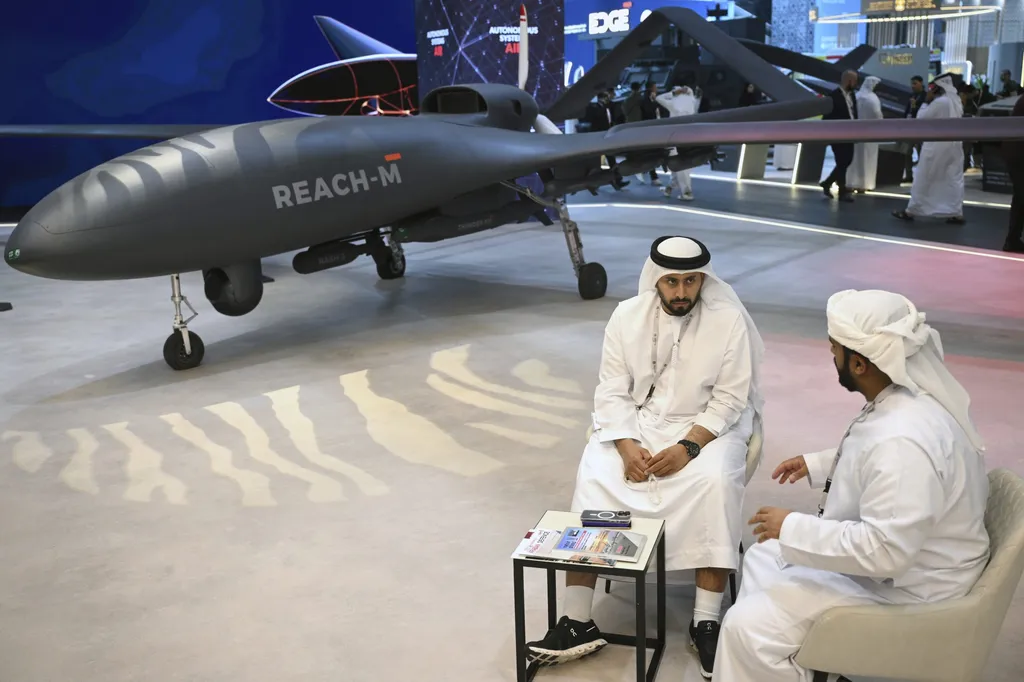
Uncrewed systems are no longer an adjunct capability in Gulf defence planning. Across the Gulf Cooperation Council (GCC), drones and autonomous platforms are becoming a core focus of the military, shaping how airspace is controlled, borders are secured, and force is projected. This evolution reflects both regional realities and global lessons, positioning the Gulf as a leader in integrating autonomy, artificial intelligence, and system-level coordination across air, land, and sea.
### Platforms and Systems
Early drone adoption in the GCC focused on individual platforms, primarily medium-altitude long-endurance systems used for intelligence, surveillance, and reconnaissance. Over the past decade, however, defence planners have moved beyond platform acquisition towards system integration. Drones are now being deployed as part of multi-layered architectures that link sensors, command and control, manned aircraft, air defence, and naval assets.
Saudi Arabia’s growing interest in high-end long-endurance drones reflects this shift. Rather than viewing uncrewed aircraft as isolated strike or surveillance tools, the Kingdom is positioning them as persistent eyes and ears across its airspace and borders. The same logic is evident in the UAE, where unmanned systems are being integrated into joint operational concepts spanning the air, maritime, and land domains. This evolution mirrors a broader change. Modern defence strategies increasingly prioritise situational awareness, data fusion, and decision speed over traditional platform-centric superiority. Uncrewed systems, with their ability to loiter, network, and operate autonomously or semi-autonomously, are uniquely suited to this environment.
### Dual-Use Capability
One of the key features of the Gulf’s uncrewed systems strategy is the emphasis on dual-use applications. Military requirements have accelerated adoption, but civil and security agencies are now among the most active users of uncrewed technologies. Border surveillance, maritime domain awareness, and critical infrastructure protection are increasingly supported by drones equipped with advanced sensors and AI-driven analytics. In desert regions and offshore environments, uncrewed platforms provide persistent coverage that would be prohibitively expensive or risky using manned assets alone.
Logistics is emerging as another key area. Trials involving cargo drones for medical supplies, postal services, and remote deliveries are laying the groundwork for autonomous logistics networks that could support both civilian resilience and military sustainment. In crisis or conflict scenarios, the ability to move supplies autonomously across contested or hard-to-reach terrain is becoming a strategic advantage. The dual-use nature of these systems also strengthens the business case for investment. Civil applications help justify infrastructure development, regulatory reform, and local manufacturing, while defence requirements drive performance, reliability, and security standards.
### Maritime Autonomy and Offshore Security
While aerial drones dominate public attention, maritime uncrewed systems are becoming just as strategically significant for the Gulf. With some of the world’s most critical shipping lanes and energy infrastructure under constant threat, uncrewed surface and subsurface vessels are increasingly central to naval planning. Uncrewed maritime platforms are being deployed for surveillance, mine countermeasures, port security, and offshore patrol. Their ability to operate for extended periods, enter high-risk zones, and coordinate with aerial drones makes them particularly valuable in congested and contested waters.
The integration of maritime and aerial uncrewed systems is a notable trend. Data from surface vessels, underwater sensors, and drones is being fused to provide a comprehensive picture of maritime activity, enabling faster response and more effective deterrence. This multi-domain approach reflects a broader shift towards networked defence architectures across the GCC.
### The Rise of Swarming Concepts
Artificial intelligence is the engine driving the transformation of uncrewed systems. Autonomy is no longer limited to basic navigation or waypoint following. Advanced AI is enabling drones to interpret sensor data, adapt flight paths, coordinate with other platforms, and operate effectively in degraded communications environments. Swarming technology is among the most disruptive developments. Rather than relying on a single high-value platform, swarms of smaller, networked drones can overwhelm defences, conduct distributed sensing, or execute coordinated missions. For Gulf militaries facing asymmetric threats and saturation attacks, swarm concepts offer both offensive and defensive advantages.
At the same time, counter-uncrewed systems have become a priority. The proliferation of low-cost drones has made airspace more contested, driving investment in detection, electronic warfare, and kinetic interception capabilities. Exercises and demonstrations increasingly focus on both deploying and defeating autonomous systems, underscoring the dual nature of the challenge.
### Integration into Civilian Airspace
As uncrewed operations expand, airspace integration has become a critical enabler. GCC regulators are moving beyond restrictive frameworks towards structured integration that allows drones and advanced air mobility platforms to operate safely alongside traditional aviation. The UAE has taken a leading role, developing dedicated air corridors and digital airspace management concepts designed to support drones and air taxis. These initiatives are not limited to commercial applications. Defence and security agencies stand to benefit from clearer rules, improved coordination