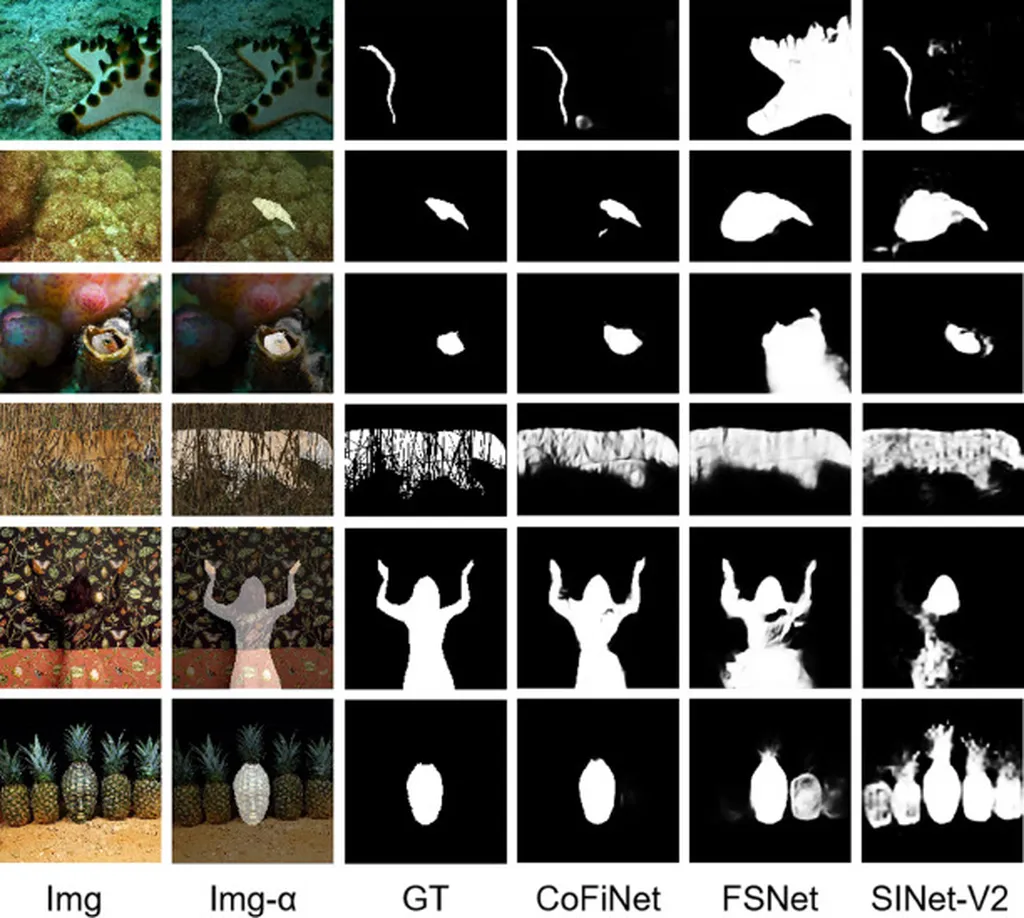
In the ever-evolving field of computer vision, the ability to detect camouflaged objects has emerged as a critical challenge with far-reaching implications for military, industrial, medical, and monitoring applications. A groundbreaking study by researchers Cunhan Guo and Heyan Huang introduces CoFiNet, a novel method designed to revolutionize camouflaged object detection (COD) by addressing the persistent issue of poor detail segmentation.
At the heart of CoFiNet lies a sophisticated approach that prioritizes multi-scale feature fusion and extraction. The researchers emphasize the importance of enhancing the model’s segmentation effectiveness for detailed features, a capability that is crucial for accurately identifying concealed objects. The method employs a coarse-to-fine strategy, which systematically refines the detection process to achieve superior results.
One of the standout features of CoFiNet is its multi-scale feature integration module. This module significantly boosts the model’s ability to fuse context features, allowing it to capture a broader range of visual information. Additionally, the multi-activation selective kernel module grants the model the flexibility to autonomously alter its receptive field. This adaptability enables CoFiNet to selectively choose an appropriate receptive field for camouflaged objects of varying sizes, a feature that enhances its precision and reliability.
During the mask generation phase, CoFiNet employs a dual-mask strategy for image segmentation. This strategy separates the reconstruction of coarse and fine masks, a technique that significantly enhances the model’s learning capacity for fine details. By focusing on both coarse and fine features, CoFiNet ensures a comprehensive and accurate detection process.
The researchers conducted extensive experiments on four different datasets to validate the effectiveness of CoFiNet. The results were impressive, demonstrating that CoFiNet achieves state-of-the-art performance across all datasets. This robust performance underscores the model’s potential for a wide range of practical applications, from military surveillance to medical imaging.
The implications of CoFiNet’s advancements are profound. In the military domain, the ability to detect camouflaged objects can enhance situational awareness and improve tactical decision-making. Industrial applications may include quality control and defect detection in manufacturing processes. In the medical field, CoFiNet could aid in the identification of subtle anomalies in medical images, potentially leading to earlier diagnoses and better patient outcomes. For monitoring applications, such as wildlife conservation or environmental monitoring, CoFiNet’s precision could provide valuable insights and support informed decision-making.
As the field of computer vision continues to evolve, innovations like CoFiNet represent a significant step forward in addressing complex challenges. The research by Guo and Huang not only highlights the importance of multi-scale feature fusion and extraction but also demonstrates the potential of advanced segmentation techniques in enhancing object detection capabilities. With its impressive performance and broad applicability, CoFiNet is poised to make a substantial impact on various industries and applications, paving the way for future advancements in camouflaged object detection. Read the original research paper here.