
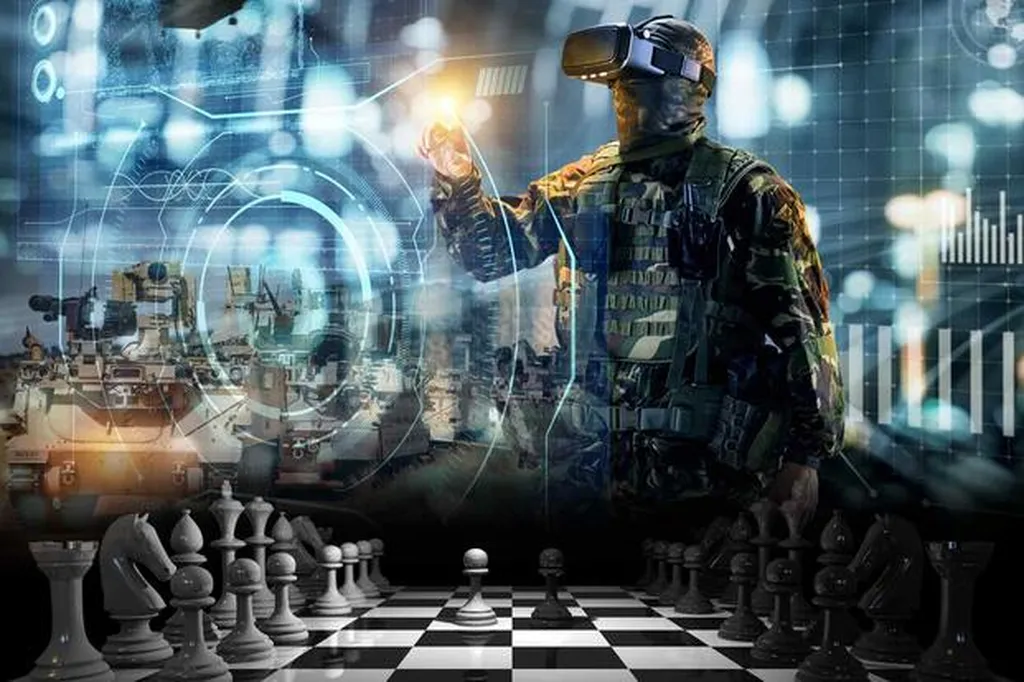
In the realm of artificial intelligence and military strategy, a groundbreaking study has emerged that could redefine how we approach complex wargaming simulations. Researchers Guilherme Palma, Pedro A. Santos, and João Dias have developed a novel system that integrates Recurrent Neural Networks (RNNs) with AlphaZero, a state-of-the-art Reinforcement Learning algorithm, to tackle the intricate challenges posed by Hex and Counter Wargames. These games are adversarial two-player simulations that mirror real-world military conflicts, characterized by their complex strategic decision-making processes.
Unlike traditional board games, Hex and Counter Wargames feature a myriad of variables, including intricate terrain and unit interactions, unit stacking, large and varied map sizes, and simultaneous move and combat decisions involving hundreds of units. The researchers’ innovative system leverages a new Neural Network architecture, building upon existing research to create state and action representations specifically tailored to these game environments. This approach allows the AI to navigate the nuanced and multifaceted nature of these simulations with remarkable efficiency.
One of the standout achievements of this research is the system’s ability to generalize across different terrains and tactical situations with minimal training. This adaptability is crucial for military applications, where unpredictable environments and rapidly changing conditions are the norm. The system’s capacity to perform well in various scenarios underscores its potential as a valuable tool for strategic planning and training.
The researchers also explored the system’s scalability, investigating its potential to handle larger map sizes. This aspect is particularly significant for military strategists, as it allows for the simulation of large-scale conflicts with a high degree of fidelity. The ability to scale effectively ensures that the system remains relevant and useful in a wide range of strategic contexts.
Moreover, the developed system is openly accessible, encouraging continued research and exploration within this challenging domain. By making their work available to the broader research community, the authors invite collaboration and further innovation, potentially accelerating advancements in AI-driven military strategy.
The implications of this research extend beyond the confines of academic study. In the defence and security sector, the ability to simulate complex military scenarios with high accuracy and adaptability can provide invaluable insights. It can aid in the development of strategic plans, the training of military personnel, and the evaluation of potential outcomes in various conflict scenarios. The integration of AI in these simulations offers a powerful tool for decision-makers, enabling them to make more informed and strategic choices.
As we look to the future, the potential for AI to revolutionize military strategy and planning becomes increasingly apparent. The work of Palma, Santos, and Dias represents a significant step forward in this field, demonstrating the potential of cutting-edge AI technologies to address the complex challenges of modern warfare. Their research not only advances our understanding of AI capabilities but also paves the way for innovative applications in defence and security. Read the original research paper here.