
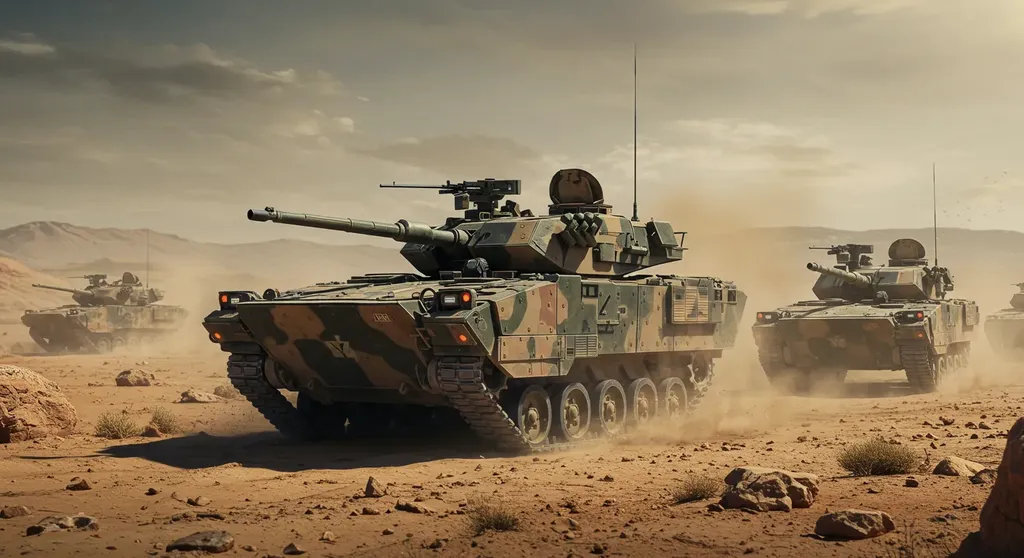
In the rapidly evolving landscape of defence technology, the ability to accurately classify military vehicles in challenging environments is crucial. A recent study has shed light on the occlusion robustness of vision-language models (VLMs) like CLIP, which are increasingly being explored for their potential in defence applications. This research, conducted by a team of experts including Jan Erik van Woerden, Gertjan Burghouts, Lotte Nijskens, Alma M. Liezenga, Sabina van Rooij, Frank Ruis, and Hugo J. Kuijf, offers valuable insights into the capabilities and limitations of these models in real-world scenarios.
The study focuses on CLIP, a model that enables zero-shot classification by aligning images and text in a shared embedding space. This feature is particularly advantageous in defence contexts where labeled data is often scarce. However, the robustness of CLIP in environments characterized by partial occlusion and degraded signal-to-noise ratio (SNR) has remained underexplored until now.
To address this gap, the researchers investigated the robustness of various CLIP variants to occlusion using a custom dataset comprising 18 military vehicle classes. They evaluated the models’ performance using the Normalized Area Under the Curve (NAUC) across different occlusion percentages. The findings reveal several key insights that could shape the future development and deployment of vision-language models in defence applications.
Firstly, the study found that Transformer-based CLIP models consistently outperformed Convolutional Neural Networks (CNNs). This suggests that Transformer architectures may be better suited for handling the complexities of military environments, where objects of interest are often partially obscured. Secondly, the researchers discovered that fine-grained, dispersed occlusions degrade performance more than larger, contiguous occlusions. This highlights the need for models that can effectively handle a variety of occlusion patterns, not just those that are large and uniform.
Thirdly, the study revealed that despite improvements in accuracy, the performance of linear-probed models sharply drops at around 35% occlusion. This indicates a critical threshold beyond which these models struggle to maintain their effectiveness. Finally, the researchers found that by fine-tuning the model’s backbone, this performance drop occurs at more than 60% occlusion. This suggests that fine-tuning can significantly enhance the robustness of CLIP models, making them more reliable in challenging conditions.
The implications of these findings are profound for the defence and security sector. The results underscore the importance of occlusion-specific augmentations during training and the need for further exploration into patch-level sensitivity and architectural resilience. By addressing these factors, developers can create more robust and reliable models that are better equipped to handle the complexities of real-world deployment.
As the defence landscape continues to evolve, the integration of advanced technologies like vision-language models will play a pivotal role in enhancing situational awareness and decision-making. This research provides a crucial stepping stone in that direction, offering valuable insights that can guide the development of more resilient and effective defence systems. Read the original research paper here.