
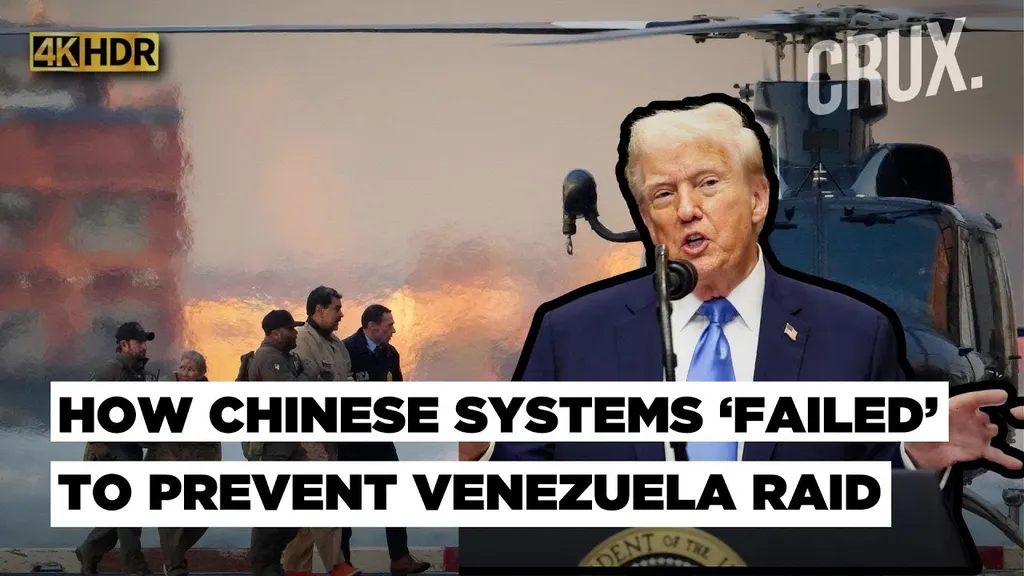
In the rapidly shifting landscape of global geopolitics, the dramatic capture of Venezuelan President Nicolas Maduro has sent shockwaves through international relations, particularly in how it exposes the vulnerabilities of China’s defence systems and strategic ambitions. The event, which saw Maduro swiftly removed from power, has become a focal point for discussions on the efficacy of China’s military technology and its broader geopolitical strategy.
The operation to capture Maduro was not just a high-stakes raid but a stark revelation of the limitations of China’s defence capabilities in Latin America. Beijing’s special envoy for Latin American affairs, Qiu Xiaoqui, had just concluded a meeting with Maduro when the raid took place. This timing, coupled with China’s state-controlled media revealing that the People’s Liberation Army had been war-gaming combat scenarios with the United States in South America, underscores the high stakes involved.
Maduro’s final act as president was overshadowed by a flurry of other global events, including a billion-dollar Somali fraud scandal, the potential collapse of Iran’s Islamic Republic, and the acquisition of Alaska. The rapid shift in focus highlights the transient nature of news cycles and the increasing complexity of global geopolitical dynamics. As one observer noted, “We’re playing civilisational pin the tail on Schrodinger’s cat.”
The capture of Maduro has also reignited debates about the effectiveness of China’s defence systems. The raid exposed significant flaws in Venezuela’s Chinese JY-27A radar, which was marketed as a stealth-killing powerhouse capable of detecting advanced aircraft like the F-35. However, the system failed spectacularly during the U.S. operation, leaving Beijing embarrassed and questioning the reliability of its defence exports.
“Venezuela’s Chinese JY-27A radar – hyped by Beijing as a stealth-killing powerhouse capable of spotting low-observable jets like the F-35 – suffered a catastrophic flop during the US raid,” reported the Washington Times. The radar’s inability to detect American stealth incursions has raised serious doubts about China’s air-defence ambitions and its ability to counter advanced U.S. military platforms.
This failure is not an isolated incident. Earlier, India successfully neutralised Chinese-made Pakistani air defence systems during Operation Sindoor, further highlighting the vulnerabilities of China’s military technology. These incidents underscore the critical role of electronic warfare in modern conflicts, where the success of conventional weapons often hinges on the outcome of a silent battle fought in the digital realm.
China’s strategic investments in Latin America, particularly through its Belt and Road Initiative, have positioned it as a significant player in the region. However, the capture of Maduro has exposed the risks associated with these investments. As noted by the Diplomat, “The screens shown by CCTV from the wargame … illustrate how Beijing is thinking about conducting military activities in the Western Hemisphere in the context of a broader war with the West.”
The implications of China’s military activities in Latin America extend beyond the region. The potential for China to leverage its access to space facilities in countries like Argentina, Venezuela, Bolivia, and Chile raises serious concerns about its ability to disrupt global combat operations by blinding, jamming, or destroying Western satellites. This strategic positioning challenges the traditional security frameworks of the United States and its allies.
The capture of Maduro also highlights the shifting dynamics of global alliances and the role of protest movements. The ‘Flags R Us’ cohort, which distributes flags to various protest movements, has become a symbol of the fluid and often contradictory nature of modern activism. As one observer noted, “It’s getting increasingly difficult to give these professional protesters credit when they come out on the streets shouting, ‘Stop fascism! Let the communist dictator go! Oh! And protect the Ayatollah!!!’”
The failure of China’s defence systems in Venezuela serves as a cautionary tale for Beijing and its allies. It underscores the need for continuous innovation and adaptation in the face of evolving military technologies. As the world moves towards an era of electronic warfare, the integrity and reliability of defence systems will be critical in determining the outcomes of future conflicts.
In the wake of Maduro’s capture, the geopolitical landscape continues to evolve, with new alliances forming and old ones being tested. The capture of Maduro is a stark reminder of the complexities and uncertainties of the modern world, where the actions of one nation can have far-reaching consequences across the globe. As the world watches, the lessons from this event will shape the future of international relations and defence strategies.