
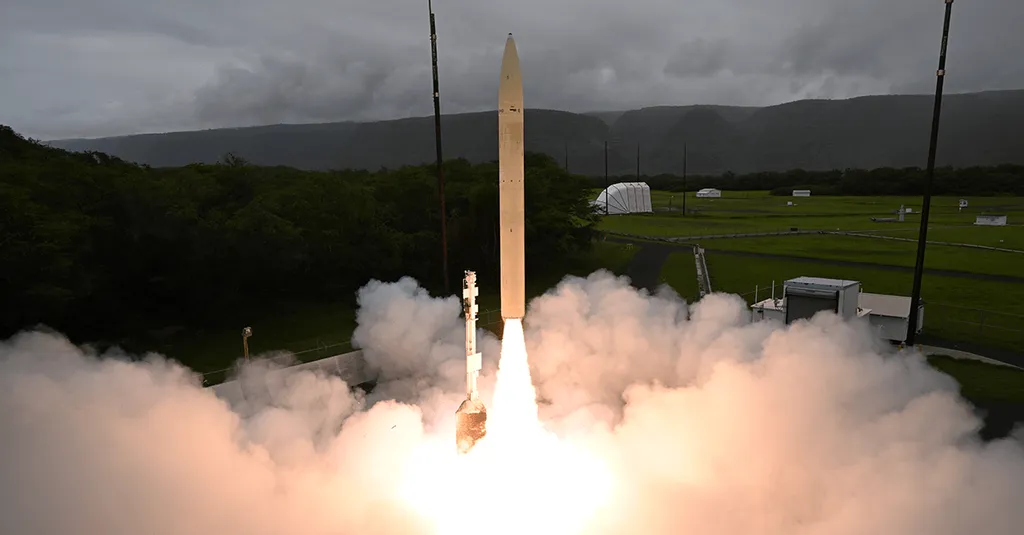
The U.S. Navy’s recent test launch of a hypersonic missile from Wallops Island, Virginia, underscores the rapid advancements in military technology that are reshaping the global defence landscape. As nations race to develop and deploy cutting-edge systems, the U.S. Congressional Research Service (CRS) has highlighted several emerging technologies that could significantly impact national security and military operations in the coming years.
In a January 2024 report, the CRS identified artificial intelligence (AI), lethal autonomous weapon systems (LAWS), hypersonic weapons, directed energy weapons, biotechnology, and quantum technology as key areas of concern. These technologies, as they mature, could influence congressional oversight, defence authorisations, military strategies, and the future of warfare.
Artificial Intelligence
AI is already being integrated into various military applications, including intelligence, surveillance, reconnaissance, logistics, cyber operations, and autonomous vehicles. The U.S. government categorises AI into narrow AI, artificial general intelligence (AGI), and artificial super-intelligence. Narrow AI systems, which are currently in use, can perform specific tasks but lack the broader cognitive abilities of AGI or super-intelligence systems, which do not yet exist.
The integration of AI into military systems offers several advantages, such as faster reaction times, the ability to process vast amounts of data, and the potential to enable new operational concepts like swarming. However, AI systems are not without challenges. Algorithmic bias, resulting from biased training data or models, could lead to significant issues in military applications. For instance, facial recognition programs have been found to exhibit racial bias, while natural language processing systems have developed gender bias. These biases could have profound implications for military operations.
Lethal Autonomous Weapon Systems
LAWS represent a class of weapon systems capable of independently identifying and engaging targets without human intervention. These systems rely on advanced algorithms and sensor suites to classify objects as hostile and guide weapons to their targets. LAWS could operate effectively in environments where traditional systems might fail, such as in communications-degraded or -denied scenarios.
However, the development and deployment of LAWS raise ethical concerns. Senior military leaders, including former Vice Chairman of the Joint Chiefs of Staff General Paul Selva, have expressed reservations about entrusting life-and-death decisions to autonomous systems. Currently, there are no domestic or international legal prohibitions on the development of LAWS, although approximately 30 countries have called for a preemptive ban. The U.S. Department of Defense (DOD) Directive 3000.09 provides guidelines to ensure that LAWS comply with the law of war, applicable treaties, weapon system safety rules, and rules of engagement.
Hypersonic Weapons
Hypersonic weapons, which travel at speeds of at least Mach 5, are being developed by several countries, including the United States, Russia, and China. These weapons are categorised into hypersonic glide vehicles (HGVs) and hypersonic cruise missiles (HCMs). HGVs are launched from a rocket and glide to their target, while HCMs are powered by high-speed engines throughout their flight. Unlike ballistic missiles, hypersonic weapons do not follow a predictable trajectory, making them difficult to defend against.
The strategic implications of hypersonic weapons are a subject of debate. Some analysts argue that their short time-of-flight and unpredictable flight paths could compress response timelines and heighten the risk of miscalculation or unintended escalation. Others contend that the strategic impact is minimal, given that countries like China and Russia already possess intercontinental ballistic missiles capable of overwhelming U.S. missile defences.
Directed Energy Weapons
Directed energy (DE) weapons use concentrated electromagnetic energy to incapacitate, damage, disable, or destroy enemy equipment, facilities, and personnel. These weapons, often referred to as lasers, could be used in counter rocket, artillery, and mortar (C-RAM) or short-range air defence (SHORAD) missions. DE weapons offer the potential for low-cost, high-efficiency defence against missile salvos and swarms of uncrewed vehicles.
High-powered microwave (HPM) weapons, a subset of DE weapons, could disable electronics, communications systems, and improvised explosive devices. The U.S. military has also explored using HPM in non-lethal crowd control systems, although such applications have been recalled, likely due to ethical and operational considerations.
Biotechnology
Biotechnology leverages life sciences for technological applications, with potential implications for national security. Advances in biotechnology, such as the gene-editing tool CRISPR-Cas9, could modify genes or create DNA to enhance or degrade the performance of military personnel. Synthetic biology, which creates genetic code that does not exist in nature, could enable the development of chemical and biological weapons, as well as adaptive camouflage, cloaking devices, and advanced body and vehicle armour