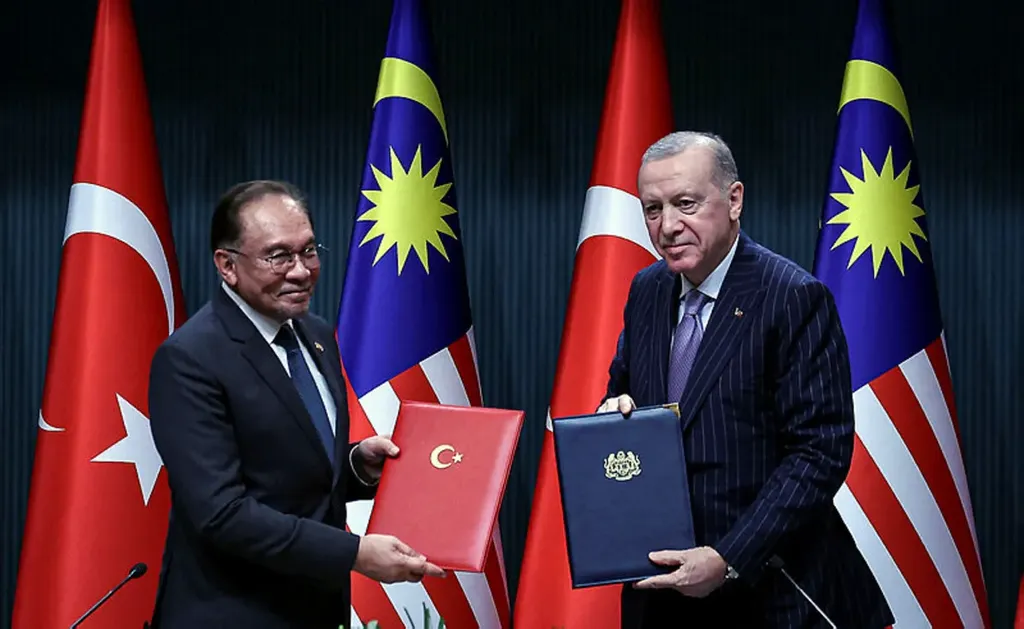
Türkiye and Malaysia have agreed to significantly deepen bilateral cooperation across trade, defence, energy, technology, and people-to-people exchanges following the inaugural meeting of the High-Level Strategic Cooperation Council (HLSC). Co-chaired by Turkish President Recep Tayyip Erdoğan and Malaysian Prime Minister Datuk Seri Anwar Ibrahim, the meeting in Ankara marked a major milestone in the two countries’ comprehensive strategic partnership, providing a formal platform to review existing cooperation and chart a long-term roadmap for closer engagement.
Trade, Investment, and Connectivity in Focus
Both leaders reaffirmed their ambition to raise bilateral trade to USD10 billion, underscoring the importance of maximising the Malaysia–Türkiye Free Trade Agreement while expanding cooperation into new sectors such as agriculture, manufacturing, digital trade, services, and the global halal economy. “We are committed to leveraging our economic strengths to foster mutual growth and prosperity,” President Erdoğan stated.
The two sides also agreed to strengthen bilateral investments and connectivity, particularly in logistics, maritime transport, port development, aviation, and multimodal transport, as well as emerging economic corridors linking Europe, the Middle East, and the Asia-Pacific. Civil aviation cooperation, including air cargo and passenger services, was highlighted as a key enabler of economic integration.
Small and medium-sized enterprises (SMEs) were identified as another priority area, with both governments committing to promote SME development and facilitate stronger cross-border business linkages. “By supporting our SMEs, we can drive innovation and create sustainable economic opportunities for our people,” Prime Minister Anwar Ibrahim noted.
Deepening Defence and Security Cooperation
Türkiye and Malaysia pledged to further enhance defence collaboration, particularly in military science, defence technology, and the defence industry, with a focus on high-technology and mutually beneficial projects. The leaders also agreed to expand military education and training opportunities for officers and cadets from both countries.
They reaffirmed their shared commitment to combating terrorism and transnational organised crime, emphasising the importance of international cooperation in addressing evolving security threats. “Our defence and security cooperation is crucial for regional stability and global peace,” President Erdoğan remarked.
Energy Transition, Climate, and Emerging Technologies
Energy cooperation emerged as a key pillar of the partnership, with both sides expressing interest in collaboration on energy transition, renewable energy, nuclear energy, clean hydrogen, battery technologies, electricity, and energy efficiency. On climate change, the leaders reaffirmed their commitment to the Paris Agreement and the UN Sustainable Development Goals, welcoming closer engagement ahead of Türkiye’s presidency of COP31.
They also expressed readiness to cooperate on zero-waste initiatives, building on Malaysia’s support for related UN resolutions. “Our collaboration in energy and climate action will pave the way for a sustainable future,” Prime Minister Anwar Ibrahim said.
Recognising the transformative potential of emerging technologies, Türkiye and Malaysia agreed to expand cooperation in artificial intelligence, semiconductors, space and satellite technologies, biotechnology, digitalisation, and research and development, including through joint innovation platforms.
The inaugural HLSC meeting laid the foundation for a comprehensive, long-term roadmap for bilateral cooperation. Both leaders instructed their foreign ministers to convene a Joint Commission Meeting by the end of 2026 to monitor progress and agreed that the second HLSC meeting will be held in Malaysia in 2028. “This meeting is just the beginning of a new era in Türkiye-Malaysia relations,” Prime Minister Anwar Ibrahim concluded.