
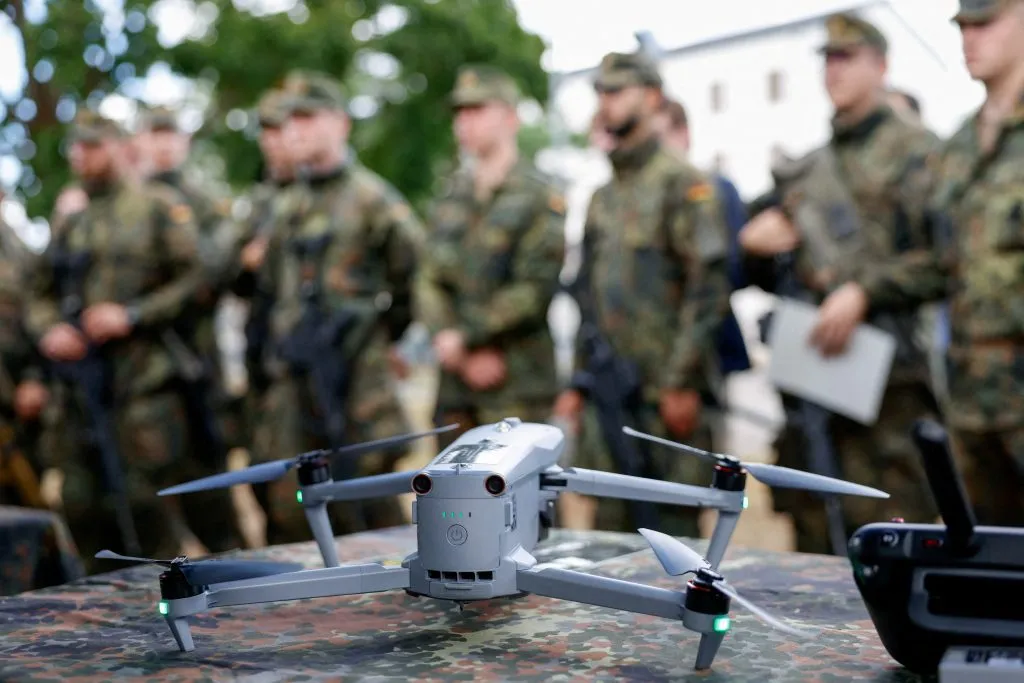
In the realm of military surveillance and reconnaissance, the ability to accurately track multiple objects in real-time is crucial for operational success. However, the challenges posed by low-frame-rate videos captured by unmanned aerial vehicles (UAVs) in combat scenarios have long been a significant hurdle. Researchers from a collaborative team have recently presented a groundbreaking solution to these challenges, offering a robust method for multi-object tracking (MOT) in low-FPS UAV footage.
The complexity of associating objects in low-frame-rate videos is compounded by rapid changes in object appearance and position within the frame, as well as image degradation caused by cloud video streaming and compression algorithms. Traditional tracking methods often struggle to maintain consistent identities of objects under these conditions. However, the research team, comprising Markiyan Kostiv, Anatolii Adamovskyi, Yevhen Cherniavskyi, Mykyta Varenyk, Ostap Viniavskyi, Igor Krashenyi, and Oles Dobosevych, has developed an innovative approach that leverages instance association learning from single-frame annotations to overcome these obstacles.
The team’s solution hinges on the utilization of global features of the scene, which provide crucial context for low-FPS instance association. This method ensures that the tracking system remains robust to distractors and gaps in detections, significantly enhancing its accuracy and reliability. The researchers demonstrated that their approach maintains high association quality even when reducing the input image resolution and latent representation size for faster inference, making it highly suitable for real-time applications.
One of the most compelling aspects of this research is the presentation of a benchmark dataset of annotated military vehicles collected from publicly available data sources. This dataset not only validates the effectiveness of the proposed tracking method but also provides a valuable resource for future research in the field of military surveillance and reconnaissance.
The research was initially presented at the NATO Science and Technology Organization Symposium (ICMCIS), organized by the Information Systems Technology (IST) Scientific and Technical Committee, IST-209-RSY, held in Oeiras, Portugal, on May 13-14, 2025. The symposium provided a platform for experts and researchers to discuss the latest advancements in military technology and their implications for global security.
The practical applications of this research are vast and transformative. For instance, in combat scenarios, the ability to accurately track military vehicles in real-time can provide critical intelligence, enhancing situational awareness and enabling swift decision-making. Additionally, this technology can be integrated into autonomous systems, improving their ability to navigate and operate in dynamic and unpredictable environments.
Moreover, the robustness of the proposed tracking method to image degradation and low-frame-rate videos makes it highly adaptable to various operational conditions. This adaptability is crucial for military applications, where environmental factors and technical limitations can significantly impact the quality of surveillance footage.
In conclusion, the research team’s innovative approach to multi-object tracking in low-FPS UAV footage represents a significant advancement in the field of military surveillance and reconnaissance. By leveraging instance association learning and global features of the scene, they have developed a robust and reliable tracking method that can operate effectively in real-time. The presentation of a benchmark dataset further underscores the potential of this technology, offering a valuable resource for future research and development. As the defence sector continues to evolve, such advancements will be instrumental in shaping the future of military operations and global security. Read the original research paper here.