
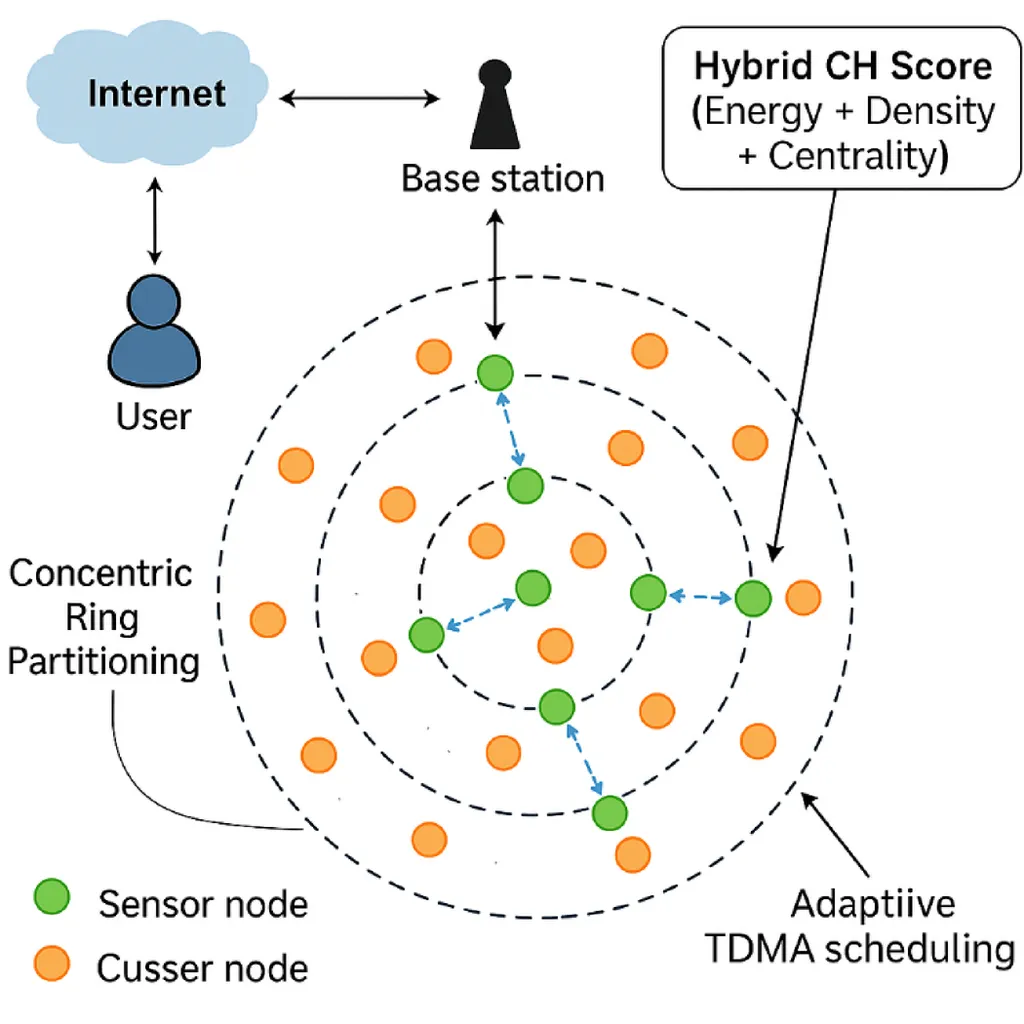
In the rapidly evolving landscape of wireless sensor networks (WSNs), the demand for efficient, secure, and adaptable operating systems has never been greater. A recent study led by Kexing Xing, Decheng Zuo, Haiying Zhou, and Hou Kun-Mean introduces a groundbreaking solution: a task and resource self-adaptive embedded real-time operating system microkernel designed specifically for wireless sensor nodes. This innovation addresses critical challenges in WSNs, including real-time multi-tasking, energy efficiency, software updates, and security.
Wireless sensor networks are pivotal in various domains, from military surveillance to healthcare and environmental monitoring. However, traditional WSN operating systems often fall short in meeting the diverse needs of these applications. Event-driven models, while efficient, struggle with real-time and multi-tasking capabilities. Conversely, thread-driven models, although capable of handling multiple tasks, consume excessive energy due to frequent context switching. The new microkernel proposed by the researchers offers a hybrid programming model that combines the strengths of both approaches, enabling seamless real-time multi-tasking without compromising energy efficiency.
One of the standout features of this microkernel is its two-level scheduling strategy. This innovative approach ensures that tasks are executed in a timely manner, catering to the real-time demands of various applications. Additionally, the researchers have incorporated a communication scheme inspired by the “LINDA” model, which uses “tuple” space and “IN/OUT” primitives. This scheme facilitates collaborative and distributed tasks, enhancing the overall functionality and flexibility of the WSN.
Security is another critical aspect addressed by this microkernel. Wireless sensor nodes are particularly vulnerable to attacks due to their broadcast communication and unattended nature. The new microkernel implements a robust security policy to protect against such threats, ensuring the reliable operation of the nodes. Furthermore, it introduces a run-time over-the-air updating mechanism, allowing for seamless software updates without the need to physically collect the sensor nodes. This feature is particularly valuable in large-scale and high-density deployments, where manual updates would be impractical.
The performance evaluation of this microkernel has yielded promising results. The researchers found that it is both task-oriented and resource-aware, making it suitable for a wide range of applications, from event-driven tasks to real-time multi-tasking. This versatility, combined with its energy efficiency and security features, positions the microkernel as a significant advancement in the field of wireless sensor networks.
The implications of this research are far-reaching. For the defence and security sector, the ability to deploy secure, efficient, and adaptable wireless sensor networks could revolutionise surveillance and monitoring capabilities. In healthcare, it could enable the development of advanced patient monitoring systems. Environmental applications could also benefit greatly, with enhanced capabilities for real-time data collection and analysis.
As the demand for sophisticated and reliable wireless sensor networks continues to grow, innovations like the task and resource self-adaptive embedded real-time operating system microkernel will play a crucial role in shaping the future of this technology. The research conducted by Kexing Xing, Decheng Zuo, Haiying Zhou, and Hou Kun-Mean represents a significant step forward, offering a comprehensive solution to the challenges faced by modern WSNs. Read the original research paper here.