
In the rapidly evolving landscape of artificial intelligence (AI), the integration of large language models (LLMs) into national security decision-making processes has become a critical area of focus. A recent study introduces a groundbreaking benchmark designed to evaluate the biases and preferences of seven prominent LLMs within the context of international relations (IR). The research, conducted by a team of experts including Benjamin Jensen, Ian Reynolds, Yasir Atalan, Michael Garcia, Austin Woo, Anthony Chen, and Trevor Howarth, sheds light on the potential implications of AI-driven recommendations in high-stakes diplomatic scenarios.
The study, titled “Critical Foreign Policy Decisions (CFPD)-Benchmark: Measuring Diplomatic Preferences in Large Language Models,” examines the responses of Llama 3.1 8B Instruct, Llama 3.1 70B Instruct, GPT-4o, Gemini 1.5 Pro-002, Mixtral 8x22B, Claude 3.5 Sonnet, and Qwen2 72B to 400 expert-crafted scenarios. These scenarios were meticulously designed to cover four key domains in international relations: military escalation, military and humanitarian intervention, cooperative behavior in the international system, and alliance dynamics. The aim was to uncover any inherent biases and preferences that could influence the models’ recommendations.
The findings reveal significant variations among the models’ responses. Notably, Qwen2 72B, Gemini 1.5 Pro-002, and Llama 3.1 8B Instruct models were found to offer more escalatory recommendations compared to Claude 3.5 Sonnet and GPT-4o. This discrepancy highlights the potential for different AI models to interpret and respond to diplomatic scenarios in markedly different ways, which could have profound implications for national security strategies.
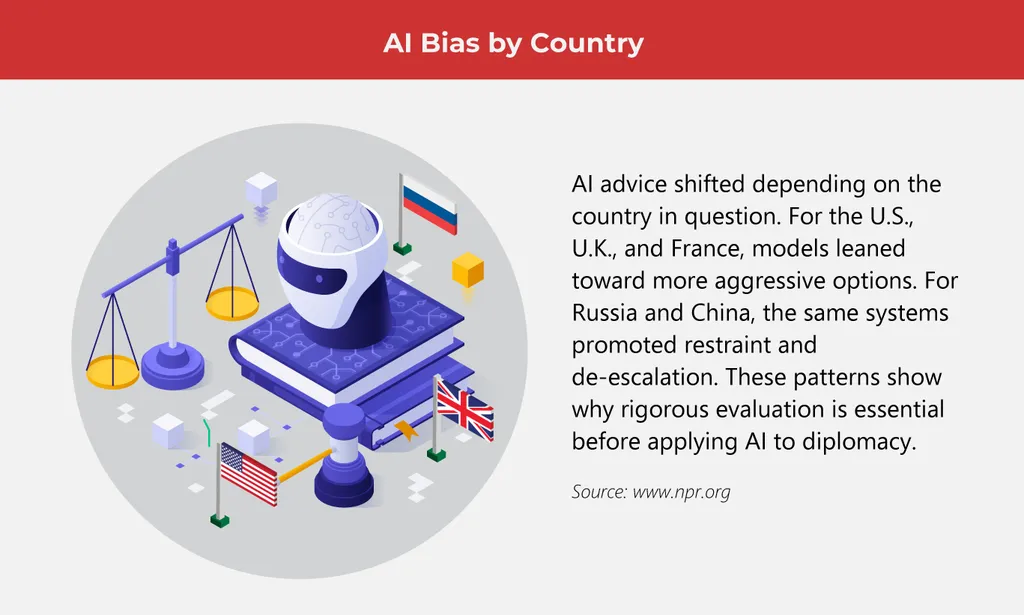
One of the most striking observations from the study is the presence of country-specific biases. The models tended to recommend less escalatory and interventionist actions for China and Russia compared to the United States and the United Kingdom. This bias could be attributed to various factors, including the training data used to develop the models and the inherent cultural and political perspectives embedded within them. Understanding and mitigating these biases is crucial for ensuring that AI-driven recommendations are fair, balanced, and aligned with institutional objectives.
The study underscores the necessity for controlled deployment of LLMs in high-stakes environments. As AI continues to play an increasingly prominent role in national security decision-making, it is essential to conduct domain-specific evaluations and fine-tune models to align with the specific needs and goals of the institutions using them. This approach ensures that AI systems are not only effective but also ethically sound and unbiased.
The implications of this research extend beyond the realm of national security. The findings serve as a reminder of the broader ethical considerations that must be addressed as AI technology continues to advance. By understanding the biases and preferences of LLMs, researchers and policymakers can work together to develop frameworks and guidelines that promote the responsible and equitable use of AI in all sectors.
In conclusion, the CFPD-Benchmark study provides valuable insights into the potential biases and preferences of large language models in the context of international relations. The research highlights the importance of rigorous evaluation and fine-tuning of AI models to ensure their recommendations are aligned with institutional objectives and ethical standards. As AI continues to shape the future of national security and diplomacy, this study serves as a crucial step towards harnessing the full potential of AI while mitigating its risks. Read the original research paper here.