
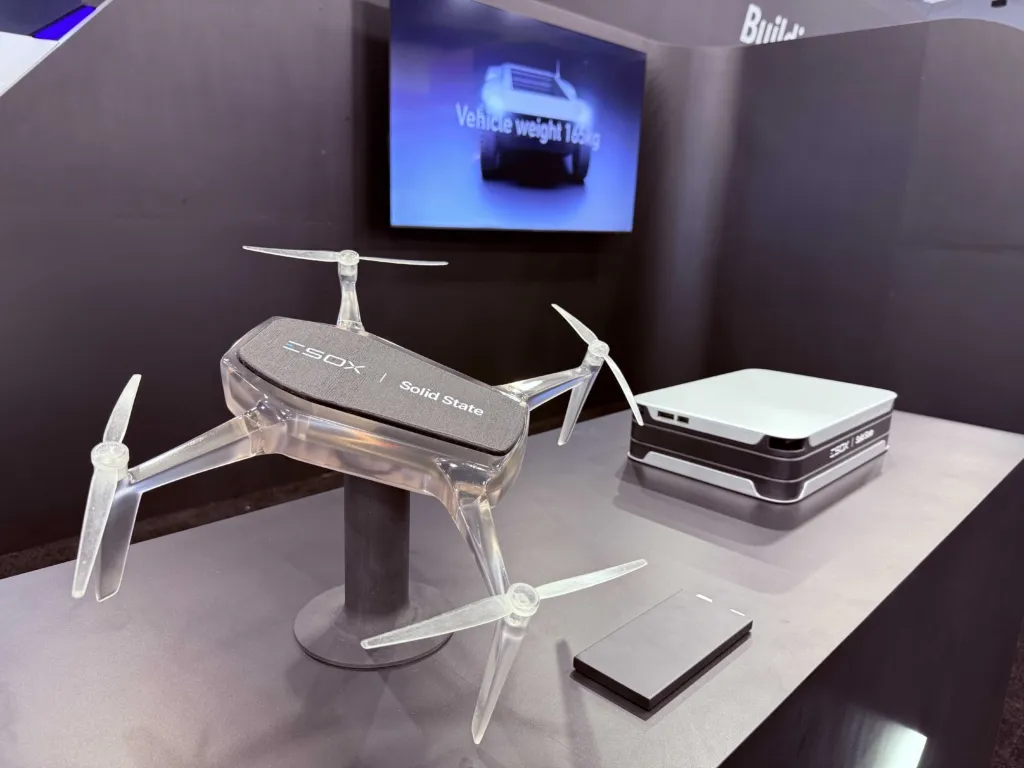
European defence technology firm ESOX Group has unveiled ambitious plans to integrate what it describes as the world’s first production-ready solid-state battery into uncrewed military platforms. This development, announced at the Consumer Electronics Show (CES), marks a significant leap in how drones and autonomous systems are powered, potentially redefining their capabilities and operational effectiveness.
Under a defence-specific licensing framework, ESOX will deploy Donut Lab’s solid-state technology across military and security applications. The company is currently completing final defence testing with selected partners, with a production ramp-up planned for the second half of 2026. This timeline aligns with qualification and integration schedules, positioning ESOX at the forefront of defence innovation.
While much of the global focus on solid-state batteries has been on consumer electric vehicles, ESOX is positioning the technology as a defence enabler, particularly for uncrewed systems where performance, survivability, and logistics resilience are tightly linked to energy storage.
At CES 2026, Donut Lab unveiled what it claims is the world’s first all-solid-state battery ready for original equipment manufacturer (OEM) vehicle manufacturing. This battery will be placed “immediately on the road” powering 2026 model Verge Motorcycles in Q1 2026. Donut Lab’s battery boasts several groundbreaking features:
– 400 Wh/kg energy density
– A full charge in five minutes, without restricting charging to 80%
– A design life of up to 100,000 cycles, with minimal capacity fade
– Strong performance at temperature extremes, retaining over 99% capacity at –30°C and above 100°C, with “no signs of ignition or degradation”
– Safety characteristics tied to chemistry and construction, including no flammable liquid electrolytes, no thermal runaway chains, and no metallic dendrites
For the EV market, these claims point to a potential triple win: lighter packs for range and packaging flexibility, dramatically faster charging, and a safer failure mode under abuse. Donut Lab also states that the battery is made from “abundant, affordable, and geopolitically safe materials,” and is priced below lithium-ion.
For defence planners, batteries are no longer a secondary subsystem. In uncrewed systems, battery performance directly shapes range, endurance, payload capacity, acoustic and thermal signature, survivability, and logistics burden. Solid-state batteries address several persistent military pain points:
– **Survivability and safety**: Removing liquid electrolytes eliminates the primary causes of battery fires and thermal runaway, improving resilience when platforms are damaged, exposed to shock, or operating in hostile environments.
– **Energy density**: At 400 Wh/kg, lighter battery packs can be traded directly for increased range, longer loiter time, or heavier sensor and effect payloads.
– **Environmental resilience**: Retaining performance from –30°C to above 100°C reduces the need for thermal management systems and improves reliability across diverse theatres.
– **Lifecycle and readiness**: A claimed 100,000-cycle design life dramatically reduces replacement rates, lowering through-life cost and improving fleet availability.
Beyond performance, ESOX highlights a strategic dimension. As NATO nations accelerate the adoption of uncrewed air and ground systems, battery demand is rising rapidly. Much of the global battery value chain remains concentrated in China. ESOX frames solid-state batteries made from geopolitically safe materials as both a capability upgrade and a supply-chain resilience measure.
ESOX is using two demonstrators at CES to showcase how it expects to integrate solid-state batteries into operational systems. The X1 interceptor drone is a cost-effective counter-UAV platform designed for long-range communications, sensor integration, and AI-enabled target acquisition and strike accuracy. Crucially, the airframe has been designed to accept custom battery geometries, allowing power systems to be optimised around mission requirements rather than constrained by legacy battery formats. ESOX plans a first flight for January 2026, with an industrialised variant expected in April 2026, making X1 the first ESOX platform expected to fly with future solid-state integration in mind.
Alongside it, the X2 UGV technology demonstrator is a compact autonomous ground platform built to showcase integrated electric propulsion, modular power architectures, and precise control. X2 serves as a rolling testbed for solid-state battery deployment and has already attracted interest from UGV manufacturers exploring integrated propulsion and power solutions.
If Donut Lab’s solid-state battery performs in defence service as claimed, ESOX’s early integration work suggests it could reshape the endurance, survivability, and supply-chain resilience of future military drones and autonomous systems. This development underscores the transformative potential of solid-state batteries in the defence sector, positioning ESOX and its partners at the