
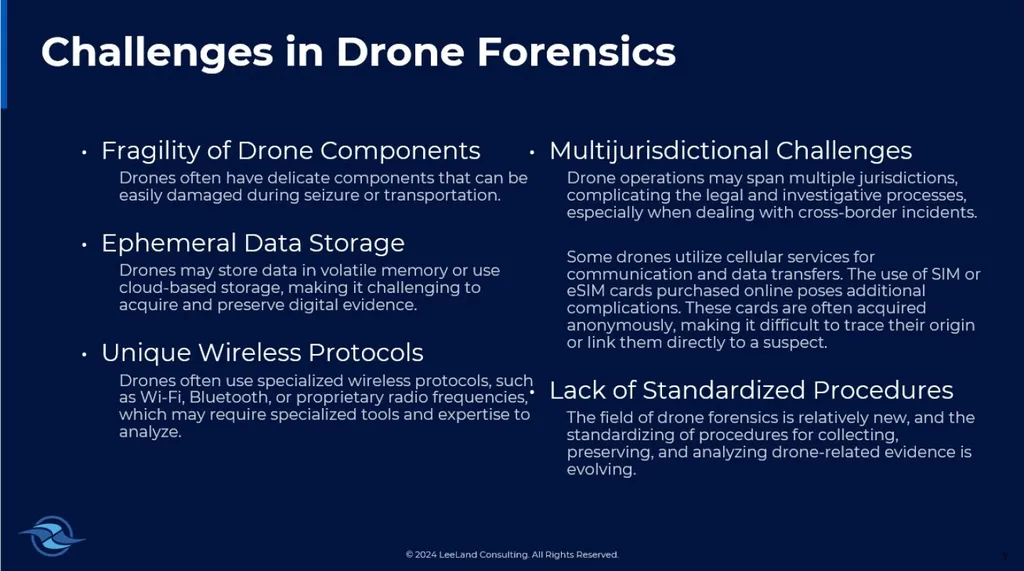
The rapid proliferation of Unmanned Aerial Vehicles (UAVs) has transformed numerous sectors, from recreational activities to military applications, thanks to advancements in mechanics and electronics that have made system design more accessible and cost-effective. However, this widespread adoption has also led to a surge in criminal activities involving UAVs. These unmanned systems are increasingly being used for illicit purposes such as smuggling narcotics, arms, and ammunition, as well as for espionage and unauthorized surveillance in restricted areas, posing significant threats to national security.
Despite the growing importance of UAVs in both legitimate and illicit activities, the field of UAV forensics remains relatively unexplored. Researchers Tanay Kumar and Mangal Kothari have delved into this emerging area, presenting new insights on UAV forensic analysis. Their work focuses on the preliminary analysis of UAVs, accessing their digital containers, and retrieving vital data that could be crucial for forensic investigations.
In their study, Kumar and Kothari outline a comprehensive methodology for analyzing data retrieved from UAVs. This methodology includes determining the flight path, identifying the source of origin, recovering flight data, and acquiring media file content. By simulating a scenario, the researchers demonstrate how forensic investigators can piece together critical information from UAVs to establish conclusions about their usage and origins.
The researchers emphasize the importance of a structured approach to UAV forensics. Preliminary analysis involves examining the physical and digital components of the UAV to gather initial clues. Accessing the digital containers, which store flight data and other critical information, is a crucial step in the forensic process. Once accessed, investigators can retrieve and analyze this data to reconstruct the UAV’s activities and determine its involvement in criminal activities.
The study highlights the potential of UAV forensics to enhance national security by providing law enforcement agencies with the tools and methodologies needed to investigate UAV-related crimes effectively. As UAV technology continues to evolve, so too must the forensic techniques used to analyze them. Kumar and Kothari’s work represents a significant step forward in this field, offering valuable insights and practical methodologies that can be applied in real-world investigations.
The practical applications of this research are vast. Law enforcement agencies can use these forensic techniques to track and dismantle criminal networks that exploit UAVs for illicit activities. Additionally, the insights gained from UAV forensic analysis can inform policy decisions and technological advancements aimed at mitigating the risks associated with UAV misuse. As the threat landscape continues to evolve, the need for robust forensic capabilities in the realm of UAVs becomes increasingly apparent.
In conclusion, the work of Kumar and Kothari underscores the critical role of forensic analysis in addressing the security challenges posed by UAVs. By developing and refining forensic methodologies, researchers and law enforcement agencies can stay ahead of criminal elements and protect national security interests. The insights provided by this research not only advance the field of UAV forensics but also contribute to the broader discourse on technology, security, and law enforcement in an increasingly interconnected world. Read the original research paper here.