
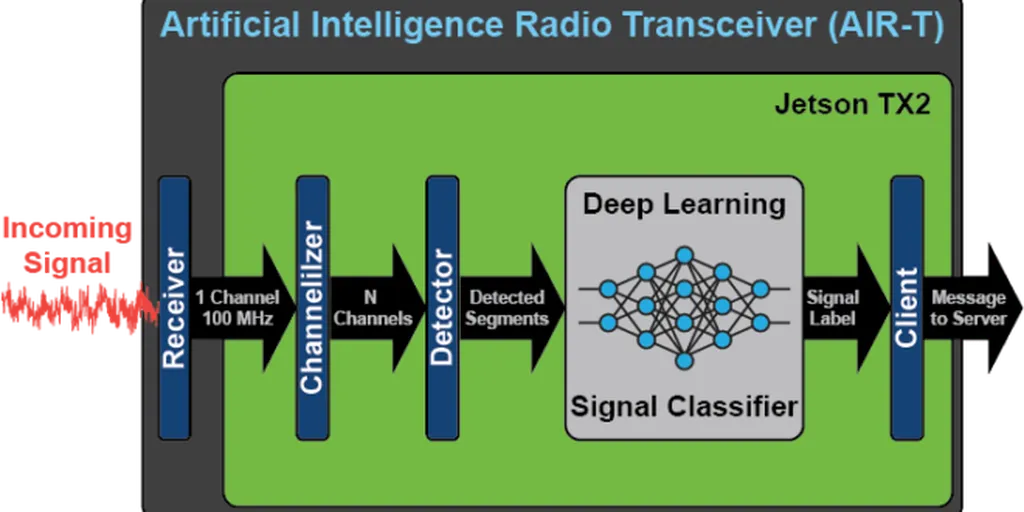
In an era where radio frequency (RF) signals are ubiquitous, the ability to identify and classify emitters with precision has become a critical capability for both defence and civilian applications. A recent study by Alex Hiles and Bashar I. Ahmad introduces a groundbreaking machine learning framework designed to revolutionise radio frequency fingerprinting (RFF) and specific emitter identification (SEI). This innovative approach promises to enhance signal intelligence, electronic surveillance, and physical-layer authentication, offering a versatile solution that adapts to various RF emitters and transmission schemes.
Radio frequency fingerprinting involves detecting unique characteristics in RF signals that can distinguish one emitter from another. This process is particularly crucial for specific emitter identification, which requires the meticulous extraction of these fingerprints to recognise individual transmitters. Traditional RFF methods, while effective, are often labour-intensive and inflexible, limiting their applicability to specific emitter types or transmission schemes. In contrast, data-driven approaches leverage machine learning to automatically learn intricate fingerprints, delivering superior performance and adaptability.
The framework presented by Hiles and Ahmad is designed to be generic and versatile, capable of handling several downstream tasks such as SEI, entity data association (EDA), and RF emitter clustering (RFEC). Unlike traditional methods, this framework is emitter-type agnostic, meaning it can be applied to a wide range of RF emitters without the need for extensive modifications. This adaptability is a significant advancement, as it allows for seamless integration into various applications, from spaceborne surveillance to countering drones and signal intelligence.
The researchers demonstrated the efficacy of their framework using real RF datasets, showcasing its potential in practical scenarios. By employing machine learning algorithms, the framework can automatically learn and extract nuanced fingerprints from RF signals, significantly enhancing the accuracy and efficiency of emitter identification. This capability is particularly valuable in defence applications, where the ability to quickly and accurately identify RF emitters can provide a strategic advantage.
The implications of this research extend beyond defence. In civilian applications, such as physical-layer authentication of wireless devices, the ability to accurately identify RF emitters can enhance security and prevent unauthorised access. Additionally, the framework’s versatility makes it a valuable tool for electronic surveillance and signal intelligence, where the ability to adapt to different emitter types and transmission schemes is crucial.
As the demand for advanced RF fingerprinting techniques continues to grow, the framework introduced by Hiles and Ahmad represents a significant step forward. By leveraging machine learning, this generic and versatile approach offers a powerful solution for a wide range of applications, from defence to civilian use. The research not only highlights the potential of data-driven methods in RF fingerprinting but also paves the way for future advancements in this critical field. Read the original research paper here.