
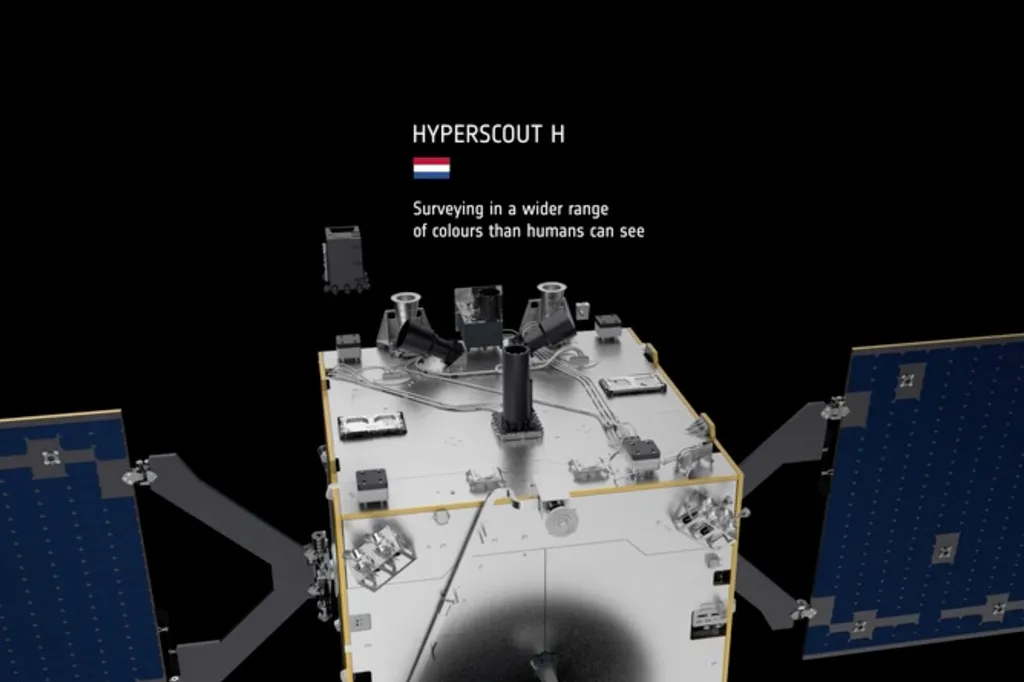
The European Space Agency’s Hera mission is set to revolutionize our understanding of planetary defence, thanks in part to the advanced capabilities of the HyperScout-H (HS-H) instrument. This versatile hyperspectral imager, aboard the Hera spacecraft, will play a crucial role in characterizing the near-Earth binary asteroid system of Didymos and its moonlet Dimorphos. Following NASA’s DART mission, which will impact Dimorphos to alter its orbit, Hera will provide detailed post-impact analysis, offering insights into the composition, space weathering, and potential presence of exogenous material on these asteroids.
The HS-H instrument is designed to capture both images and spectral data within the 0.65 to 0.95 micrometre wavelength range. Its wide field of view, approximately 15.5 degrees by 8.3 degrees, allows it to monitor the asteroid system’s orbital dynamics and dust environment. This capability ensures that both components of the binary asteroid remain within its field of view for most of the mission, providing continuous data collection. The instrument’s observations will complement data from other instruments, enhancing the characterization of the asteroids’ geomorphological units.
One of the primary objectives of the HS-H instrument is to create detailed maps that highlight key spectral features, such as taxonomic classification, spectral slope, and band parameters. These maps will be instrumental in understanding the composition and physical properties of Didymos and Dimorphos. The data collected by HS-H will also aid in assessing the impact of space weathering processes and identifying any exogenous materials that may have accumulated on the asteroids.
The pre-flight calibration of the HS-H instrument has been meticulously conducted to ensure its accuracy and reliability. Researchers have also developed a dedicated software toolbox to process the instrument’s data efficiently. This toolbox will facilitate the analysis of the spectral and imaging data, enabling scientists to extract valuable insights from the observations.
To demonstrate the instrument’s capabilities, researchers conducted laboratory observations of two meteorite samples. These tests highlighted the HS-H’s ability to provide high-quality spectral data, which is crucial for the mission’s scientific objectives. The results from these preliminary studies underscore the instrument’s potential to deliver groundbreaking insights into the nature of the Didymos-Dimorphos system.
The Hera mission, with the HS-H instrument at its core, represents a significant advancement in planetary defence and asteroid research. By providing detailed post-impact analysis and comprehensive spectral data, the mission will enhance our understanding of asteroid composition, dynamics, and the effects of space weathering. This knowledge is vital for developing effective strategies to protect Earth from potential asteroid impacts and for advancing our exploration of the solar system. Read the original research paper here.