
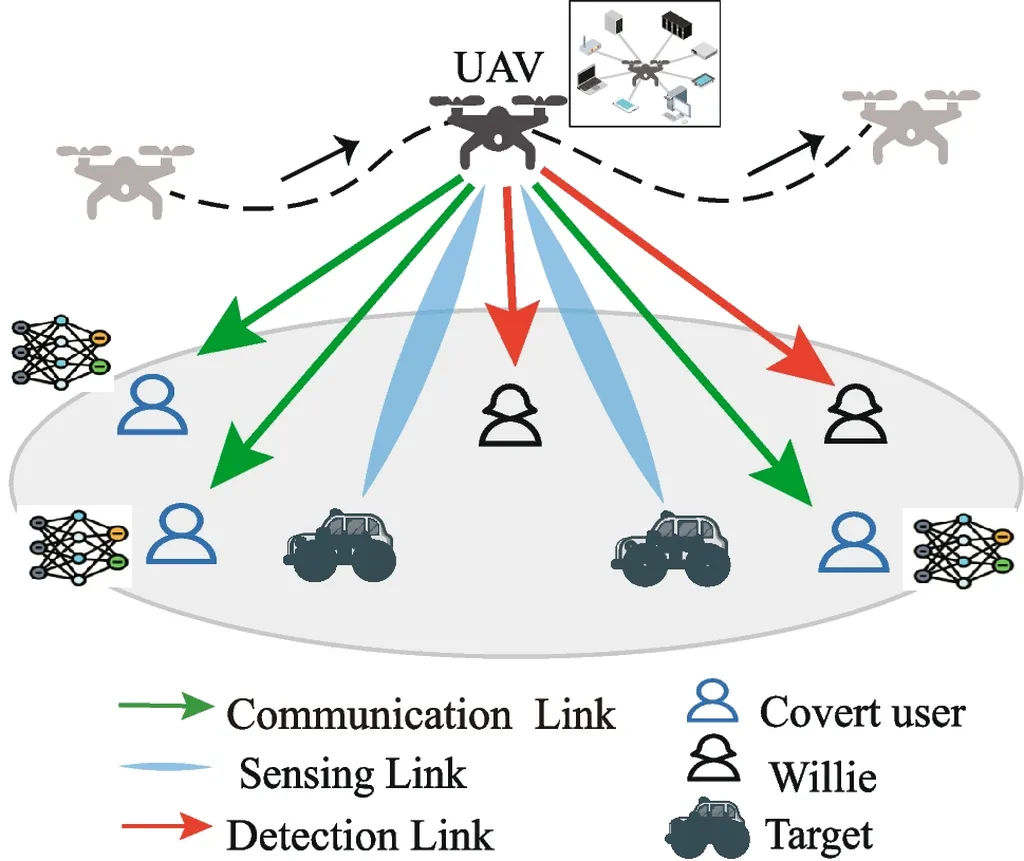
In an era where military communication networks face increasingly sophisticated threats, ensuring end-to-end security across multiple layers has become a critical challenge. Researchers have turned to covert communication as a key solution, leveraging advancements in artificial intelligence to create robust defense mechanisms. A recent study, led by Tianhao Liu and colleagues, explores the fundamentals, framework, and practical applications of Generative AI-driven cross-layer covert communication, offering insights into securing military networks against evolving threats.
The study begins by highlighting the necessity of covert communication in military contexts, where the security of transmitted data is paramount. Traditional methods of securing communication have often focused on individual layers, such as the physical, network, or application layers. However, as adversaries become more adept at eavesdropping on specific channels, the need for a more comprehensive approach has become evident. The researchers emphasize that covert communication methods, such as artificial noise, private networks, and semantic coding, can effectively transmit secret messages while evading detection.
One of the primary challenges in implementing covert communication is the accumulation of data by adversaries, which can reveal underlying patterns and compromise security. To address this, the researchers propose an end-to-end cross-layer covert communication scheme driven by Generative Artificial Intelligence (GenAI). This approach integrates AI-driven techniques to dynamically select covert schemes between nodes, thereby enhancing the security and resilience of military communication networks.
The study surveys three typical scenarios for covert communication: device-to-device, private network communication, and public network communication. Each scenario presents unique challenges and application scopes. For instance, device-to-device communication requires secure point-to-point transmission, while private and public networks involve more complex architectures with multiple nodes and potential entry points for adversaries. By analyzing these scenarios, the researchers provide a comprehensive understanding of the diverse applications and limitations of covert communication methods.
A significant contribution of the study is the proposal of a GenAI-driven framework that integrates AI techniques to optimize covert communication across layers. This framework leverages the capabilities of GenAI to adapt to changing conditions, select the most effective covert schemes, and ensure the secure transmission of data. The researchers highlight the challenges associated with implementing such a framework, including the need for real-time data processing, adaptive learning algorithms, and robust security protocols.
To validate their proposed framework, the researchers conducted a case study using diffusion reinforcement learning to solve cross-layer secure communication in cloud-edge Internet of Things (IoT) environments. This case study demonstrates the practical application of the GenAI-driven approach, showcasing its effectiveness in enhancing security and resilience in complex communication networks. The results indicate that the proposed framework can significantly improve the covertness and reliability of data transmission, even in the presence of sophisticated adversaries.
The implications of this research extend beyond military applications, offering valuable insights for securing communication networks in various sectors. As the threat landscape continues to evolve, the need for advanced security measures that can adapt to new challenges becomes increasingly critical. The GenAI-driven cross-layer covert communication framework proposed by Liu and colleagues represents a significant step forward in this direction, providing a robust and adaptable solution for securing communication networks against sophisticated threats.
In conclusion, the study by Tianhao Liu and colleagues underscores the importance of integrating AI-driven techniques into covert communication strategies. By leveraging the capabilities of GenAI, military and other critical communication networks can achieve enhanced security and resilience, ensuring the protection of sensitive data in an increasingly complex threat environment. This research not only advances our understanding of covert communication but also paves the way for future innovations in the field of network security. Read the original research paper here.