
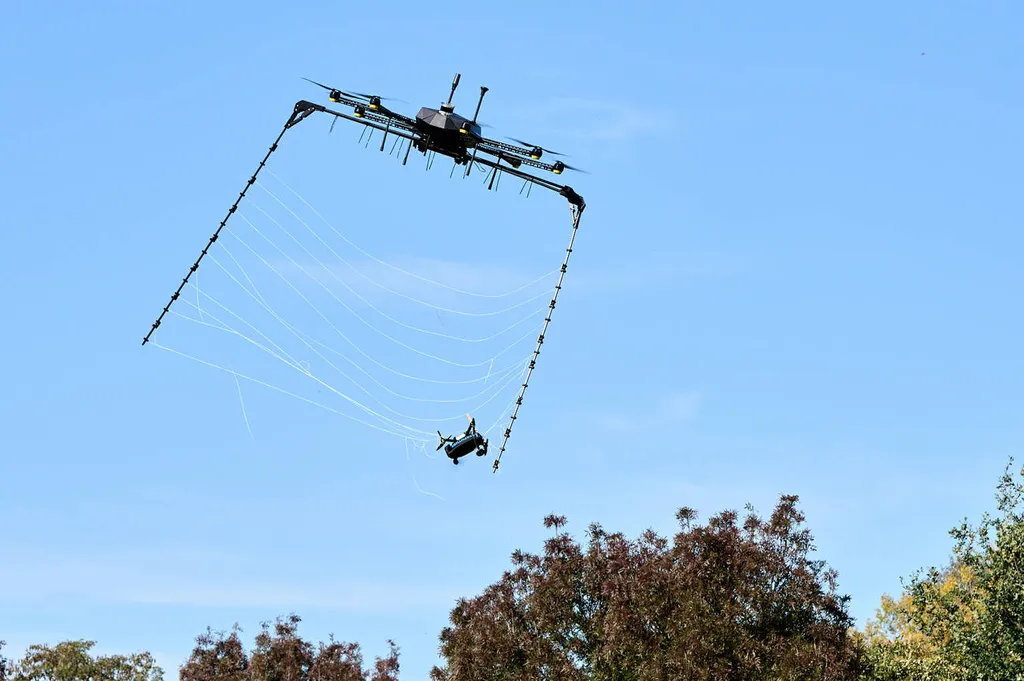
The rapid proliferation of small commercial Unmanned Aerial Vehicles (UAVs), or drones, has introduced significant security challenges for critical infrastructure such as airports, power plants, and military installations. These UAVs can disrupt radio communications, collide with other aircraft, conduct espionage, and even carry dangerous payloads. A critical aspect of safeguarding these areas involves determining the optimal number and placement of triangulating sensors to ensure comprehensive coverage while maintaining cost-effectiveness and fault tolerance.
In a groundbreaking study, researchers Marco Esposito, Toni Mancini, and Enrico Tronci have developed a novel approach to address these challenges. Their method leverages computational geometry and statistical model checking to optimize sensor deployments for UAV localization. This innovative technique not only enhances coverage under varying sensing quality levels but also ensures fault tolerance and cost efficiency. The researchers’ approach is particularly effective in large, complex 3D regions that feature obstacles like buildings, varying terrain elevations, and different coverage priorities.
One of the standout features of this research is its ability to provide a closed-form, analytical representation of the areas uncovered by sensor deployments. This capability allows for rigorous, formal certification of the quality of sensor arrangements, ensuring that critical areas are adequately protected. The study employs off-the-shelf AI-based black-box optimizers, making the solution both practical and accessible.
To demonstrate the feasibility of their approach, the researchers applied their method to two large, complex 3D regions: Rome Leonardo Da Vinci International Airport (FCO) and the Vienna International Center (VIC). Using NOMAD, a state-of-the-art optimization engine, they successfully computed optimal sensor deployments within a few hours on a standard workstation and within minutes on a small parallel infrastructure. This rapid computation time underscores the efficiency and scalability of their method.
The implications of this research for the defence and security sector are profound. By optimizing sensor deployments, critical infrastructure can be better protected against unauthorized UAV incursions. The ability to quickly and accurately determine the best sensor placements ensures that resources are used efficiently, reducing costs while maintaining high levels of security. Furthermore, the rigorous certification process provides a reliable means of verifying the effectiveness of the sensor networks, offering peace of mind for security personnel and stakeholders.
As the threat landscape continues to evolve, innovative solutions like those developed by Esposito, Mancini, and Tronci will be crucial in maintaining the safety and security of critical areas. Their work not only advances the field of computational geometry but also sets a new standard for the deployment of surveillance technologies in defence and security applications. By embracing these advancements, we can better safeguard our critical infrastructure against the growing threats posed by unauthorized UAVs. Read the original research paper here.