
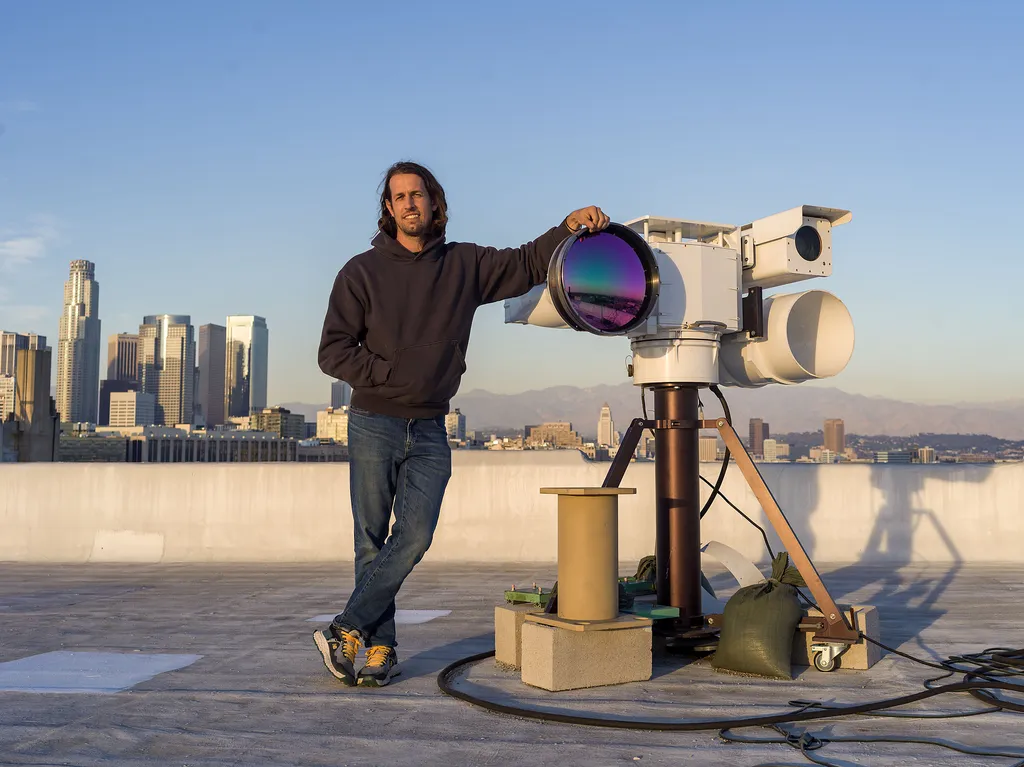
From the rooftop of his downtown Los Angeles office, Canadian entrepreneur Matt Rabinovitch is keeping a close eye on the skies. His vantage point, overlooking the flight path to Los Angeles International Airport, serves as a perfect testing ground for his cutting-edge counter-drone technology. Rabinovitch, a Toronto native, founded Teleidoscope in 2017, initially focusing on augmented-reality headsets. Today, the company has pivoted to specialize in tracking, sensing, and targeting systems, as well as autonomous products, with an impressive client list that includes Saab and the U.S. Air Force, Army, and Special Forces.
Teleidoscope’s product lineup includes AI-powered long-range tracking cameras and a rocket-based drone interceptor developed in collaboration with the Ukrainian Ministry of Defence. This interceptor can autonomously identify and neutralize threats using cameras and sensors, after receiving confirmation from an operator. Rabinovitch emphasizes the company’s adaptability, noting that Teleidoscope can provide complete systems or integrate its software with existing customer hardware. “I think that’s a pretty unique differentiator, because most companies in this space are really focused on building airframes, whereas we look at the airframe as a subcomponent,” he said.
The company’s shift from headsets to drones aligns with the growing global focus on unmanned systems and counter-drone capabilities, particularly in light of the ongoing conflict in Ukraine. Teleidoscope’s first major contract with the U.S. Department of War, valued at up to US$100 million, led to its technology being deployed to monitor airspace around Washington. The company also secured a contract with the American Army Application Laboratory to develop a tank protection system. Despite these successes, Rabinovitch is eyeing opportunities closer to home.
Canada’s recent commitment to invest $17.9 billion over five years to bolster its military capabilities, including counter-drone and long-range precision strike systems, presents a promising market for Teleidoscope. However, Rabinovitch notes that current opportunities in Canada are often limited to government grants ranging from $50,000 to $500,000, without a clear path to larger contracts. “I see a lot of potential for Teleidoscope to grow north, but I have to be careful about the risks I take,” he said, explaining that his decision to run the company without venture capital necessitates a cautious approach.
Rabinovitch’s entrepreneurial journey began in Canada, where he spent summers selling ice cream from a boat in Ontario’s Muskoka region. He later attended Queen’s University, pursuing a dual degree in commerce and computer science before moving to Montreal and eventually Los Angeles to pursue his startup dreams. His early experiences, including sharing a two-bedroom apartment with five others, even inspired Mike Judge, creator of the sitcom Silicon Valley, who visited the incubator where Rabinovitch was working.
Despite his success, Rabinovitch remains hopeful about the future of defence technology in Canada. “I’m excited to see the direction Canada is headed in,” he said, expressing optimism about the potential for Teleidoscope to contribute to the country’s defence sector. As Canada continues to invest in uncrewed systems, Rabinovitch is poised to bring his innovative technology home—if the right opportunity arises.