
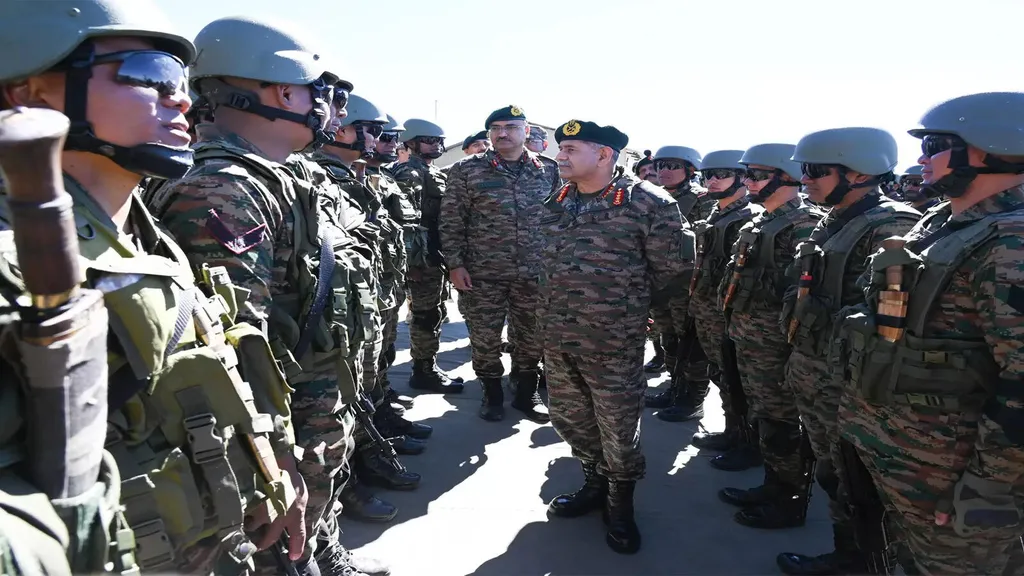
The Indian Army has declared 2025 a landmark year, marked by significant achievements in operational preparedness, technological advancement, and military capability. The year was defined by a focus on enhancing precision strike capabilities, rapid response, the induction of new technologies, and improved coordination among the Army, Air Force, and Navy. The Army also prioritized indigenous weapon systems and strengthened military cooperation with friendly nations.
Operation Sindoor, launched on May 7 following the Pahalgam terror attack, was the Army’s biggest military action of the year. The operation targeted terrorist infrastructure supported by the Pakistan Army. Planned by the Military Operations Branch and monitored from the Directorate General of Military Operations (DGMO) Ops Room, it was overseen by the Chief of Defence Staff and the three service chiefs.
During the operation, nine terrorist camps across the border were destroyed—seven by the Indian Army and two by the Indian Air Force. The Army emphasized that the strikes were conducted with high precision, within a limited timeframe and in a controlled manner to deliver a strong deterrent message.
The Army also highlighted that Pakistan’s retaliatory attempts between May 7 and 10, involving drone attacks on military and civilian installations, were successfully neutralized by India’s air defence units. This demonstrated the effectiveness of India’s layered counter-drone and air defence systems.
Along the Line of Control (LoC), more than a dozen terrorist launch pads were destroyed using ground-to-ground weapons, disrupting infiltration routes and logistical support to terrorists. On May 10, Pakistan’s DGMO contacted the Indian DGMO seeking a ceasefire, after which an agreement was reached to halt firing and military action.
The Army’s attack capability was further enhanced with the induction of AH-64E Apache attack helicopters. The first three helicopters were inducted in July, followed by the remaining three in December, making all six fully operational. These helicopters bolster the Army’s ability to counter enemy tanks and armoured vehicles.
On the technology front, the Army advanced its digital transformation drive by developing in-house software solutions such as the Edge Data Center, Equipment Helpline, and the Sainik Yatri Mitra App. The Army Commanders’ Conference held in Jaisalmer in October focused on grey-zone warfare, jointness, and innovation, highlighting threats such as cyber attacks, disinformation, economic coercion, and proxy warfare.
The indigenous air defence system IADWS was successfully tested off the coast of Odisha on August 23. India also conducted joint military exercises with several countries, including France, the United States, Thailand, Australia, Sri Lanka, the United Kingdom, and the UAE, strengthening interoperability and counter-terrorism capabilities.
Innovation remained a priority. Under the Inno-Yoddha 2025–26 initiative, the Army received 89 innovation proposals, of which 32 were selected for further development. Long-range strike capabilities were strengthened during the year. On December 1, a BrahMos unit under the Southern Command, in coordination with the Andaman and Nicobar Command, successfully conducted a combat missile launch, validating the missile’s speed and precision. Work on an extended-range version of the BrahMos is also underway.
Additionally, two new regiments of the Pinaka Multi Barrel Rocket Launcher were inducted on June 24. Towards the end of the year, the Army successfully tested the Pinaka Long Range Guided Rocket, with a strike range of about 120 kilometres, further enhancing its ability to engage distant enemy targets with accuracy.
The Southern Command of the Indian Army combat-launched the BrahMos supersonic cruise missile in the Bay of Bengal on December 1, 2025. This series of achievements underscores the Indian Army’s commitment to modernizing its capabilities and ensuring robust defence preparedness for future challenges.