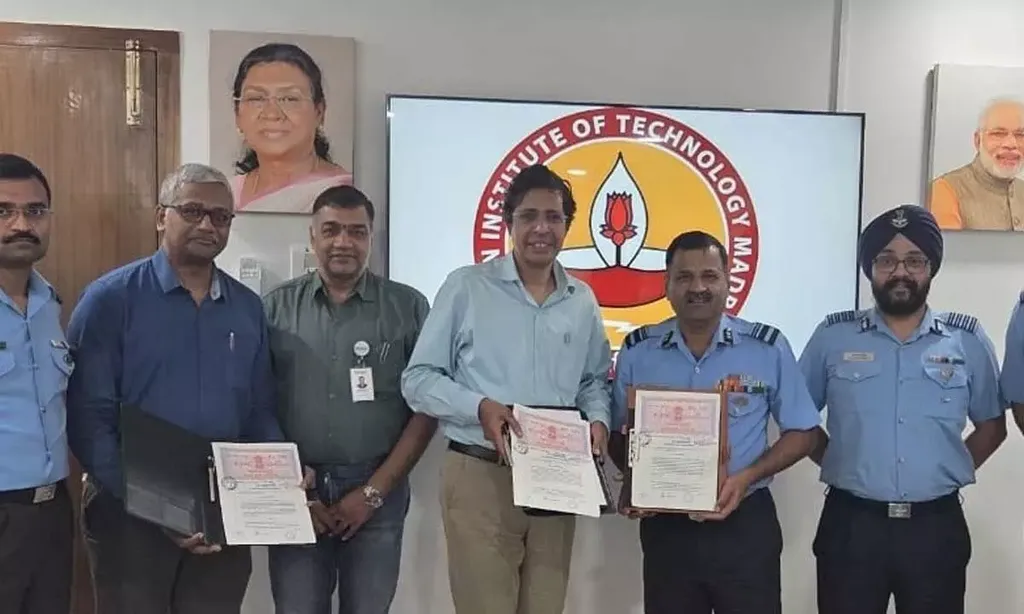
The Indian Air Force’s Software Development Institute (SDI) and the Indian Institute of Technology Madras (IIT-Madras) have joined forces to develop indigenous airborne communication systems, marking a significant stride towards India’s vision of self-reliance in defence technology. The collaboration, formalised through a Memorandum of Understanding (MoU) signed on Monday, aims to create secure networking and encryption solutions tailored for airborne military applications.
At the forefront of this initiative are Air Vice Marshal R Guruhari of SDI, Prof V Kamakoti, Director of IIT Madras, and Dr M J Shankar Raman, CEO of Pravartak Technologies Foundation. Together, they will leverage SDI’s expertise in military software and IIT-Madras’ advanced research facilities to design cutting-edge algorithms essential for safeguarding data in dynamic, networked warfare environments.
“This partnership is a cornerstone in our journey towards Atmanirbhar Bharat,” said Prof V Kamakoti. “By developing indigenous solutions, we not only reduce our dependence on imported technology but also bolster our strategic capabilities and strengthen the domestic defence industrial base.”
The project underscores the growing synergy between academia and the defence sector, highlighting how research institutions can significantly contribute to advancing national security technology. By focusing on secure networking and encryption, the collaboration aims to create robust, homegrown solutions that enhance India’s defence capabilities.
Air Vice Marshal R Guruhari emphasised the importance of this initiative: “The development of secure airborne communication systems is crucial for modern military operations. This collaboration will enable us to innovate and deploy advanced technologies that meet the unique challenges of networked warfare.”
The partnership is poised to make substantial contributions to India’s defence sector by fostering innovation and reducing reliance on foreign technology. It represents a significant step forward in building secure, reliable, and indigenous defence systems, reinforcing India’s commitment to self-sufficiency in critical technologies.
As the project progresses, it is expected to set a benchmark for future collaborations between academic institutions and defence organisations, paving the way for a more self-reliant and technologically advanced India.