
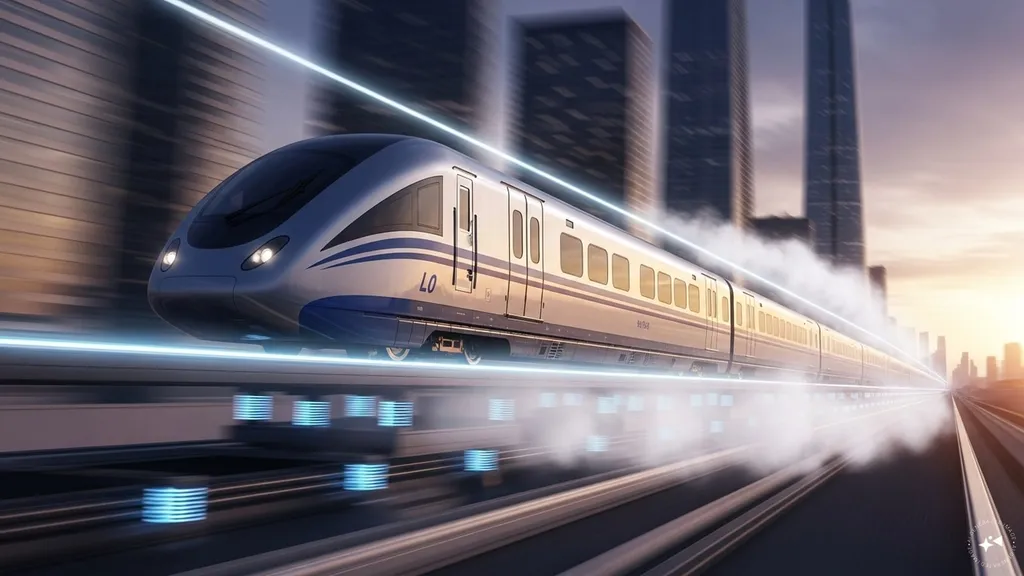
China has set a new benchmark in high-speed rail technology, achieving a groundbreaking milestone with its superconducting electric maglev train. The train, developed by researchers at the National University of Defence Technology (NUDT), reached an astonishing speed of 700 km/h in just two seconds during a test conducted on a 400-metre-long maglev track. This feat makes it the fastest maglev system ever recorded, underscoring China’s rapid advancements in next-generation transportation.
The test involved a 1-tonne vehicle that was accelerated to the record-breaking speed before being brought to a controlled and safe halt. A video of the test has since gone viral, showcasing the train as a silver streak that vanishes almost instantly, leaving behind a faint misty trail. Observers noted the train’s speed was so extreme that it disappeared from view before viewers could fully register its movement, highlighting the technological achievement.
Unlike conventional trains, maglev systems do not rely on wheels touching rails. Instead, they float above the track using powerful superconducting magnets, which both lift and propel the vehicle. This elimination of physical contact and friction allows maglev trains to achieve significantly higher speeds compared to traditional rail systems. In this test, electromagnetic acceleration was used to push the train forward with immense force, demonstrating principles that could theoretically be applied to rocket launches.
Experts believe this breakthrough could dramatically reshape future long-distance travel. At speeds approaching 700 km/h, journeys between major cities could be reduced to mere minutes, offering a potential alternative to short-haul air travel. The technology also strengthens the feasibility of future concepts such as the hyperloop, where passenger pods travel through near-vacuum tubes at ultra-high speeds. According to researchers, the successful test resolves several key technical challenges needed to make such systems viable, including ultra-high-speed electromagnetic propulsion, electric suspension guidance, transient high-power energy storage inversion, and high-field superconducting magnets.
Beyond ground transport, the technology could have major applications in space and aviation sectors. Electromagnetic launch systems could enable rockets and aircraft to achieve faster and smoother take-offs, reducing reliance on traditional fuel-based propulsion systems. Such systems may help lower fuel consumption, cut emissions, and reduce operational costs, making space launches and aviation more efficient in the long run.
Professor Li Jie of the National University of Defence Technology said the achievement marked a major milestone in China’s transport research. “The successful development of this ultra-high-speed superconducting electric maglev system will accelerate the research and development process of China’s ultra-high-speed maglev transport,” he said. The research team has reportedly been working on the project for over 10 years, with an earlier test in January achieving a top speed of 648 km/h.
China’s progress in maglev technology dates back nearly three decades. The same university developed the country’s first manned single-bogie maglev train in the 1990s, making China the third country in the world at the time to master maglev technology. Since then, the country has continued to invest heavily in high-speed rail and advanced transport systems, positioning itself as a global leader in the field.
The 700 km/h maglev test is not just a new world record but a clear signal of China’s ambitions in ultra-high-speed transportation. With continued research and scaling, such technology could redefine how people travel, connect cities faster than ever before, and open new frontiers in rail, aviation, and space technology.