
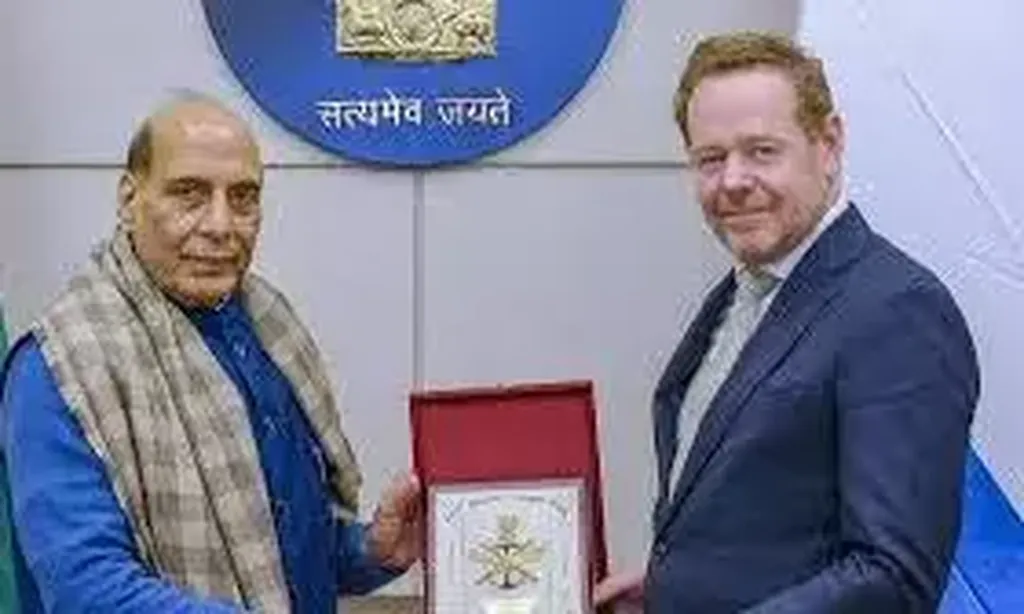
India and the Netherlands are poised to elevate their bilateral relationship into a more strategic and future-oriented partnership, with a strong emphasis on defence cooperation, high technology, and shared democratic values in emerging technologies. This shift was highlighted during Dutch Foreign Minister David van Weel’s visit to India, where he engaged in extensive discussions with External Affairs Minister S. Jaishankar and Defence Minister Rajnath Singh.
Van Weel underscored that while traditional areas of cooperation such as water management, horticulture, and agriculture will continue to expand, the evolving geopolitical landscape necessitates a deeper focus on security and defence. “The world is becoming more unsafe, and that means we want to do more together on security and defence. At the same time, there is a huge opportunity in high tech and semiconductors,” he said in an exclusive interview with NDTV.
A significant outcome of the visit was the signing of a Letter of Intent on defence cooperation, marking the beginning of a more strategic partnership, particularly in the maritime domain. The Netherlands has joined India’s Indo-Pacific initiatives as an observer and has been conducting courses on maritime rule of law for Indian students. “The Netherlands has always been an advocate of freedom of the high seas, and that is something we deeply share with India,” Van Weel noted. He added that senior Dutch naval leadership would visit India in February to discuss Indo-Pacific developments. The Dutch Foreign Minister also visited Indian shipyards to explore possibilities for collaboration between the Indian and Dutch defence industries.
High-technology cooperation, especially in semiconductors and artificial intelligence, was a prominent topic during the talks. With India set to host an Artificial Intelligence Summit next year, Van Weel confirmed that the Dutch Prime Minister is likely to attend, accompanied by the Minister of Economic Affairs. “These technologies are going to determine how our societies function in the future,” he said. “India and the Netherlands share the belief that innovation should not be suffocated, but at the same time, it needs clear guardrails so that it does not become dangerous. Strengthening democratic values in technology is something we deeply agree on.”
Highlighting the Netherlands’ strengths in the semiconductor ecosystem, Van Weel pointed to companies such as NXP, which employs over 3,000 people in India and plays a major role in chip design, including AI-capable chips. “There is a lot to build on; we are not starting from zero,” he said.
The Russia-Ukraine war was another major topic during the discussions. Van Weel described the conflict as “existential” for Europe, warning that Ukraine’s defeat would undermine fundamental principles such as sovereignty and territorial integrity. “A durable peace is what we want, but Ukraine cannot lose this war,” he said, noting that Europe has pledged 90 billion pounds in support to help Ukraine sustain its economy and military effort. While acknowledging India’s emphasis on dialogue and diplomacy, the Dutch foreign minister urged Indian leaders to use whatever influence they have to encourage Moscow to enter serious negotiations. “This is a very bloody war,” he said, citing heavy casualties on both sides. “Any effort that can lead to a durable peace, we will support.”
On counter-terrorism, Van Weel expressed condolences over recent terror attacks in India’s Pahalgam and Red Fort and reiterated the Netherlands’ commitment to working with New Delhi against extremism and radicalisation. Addressing India’s concerns about Dutch defence exports to Pakistan, he clarified that the delivery of two ocean patrol vessels was part of an older contractual agreement. “In all weapon exports, we carefully assess the end user and the intended use,” he said. “We do not wish to contribute to extremism or instability in any way.”
As geopolitical uncertainties mount and technology reshapes global power equations, Van Weel said India and the Netherlands are increasingly aligned in their strategic outlook. “This visit shows that our partnership is no longer limited to traditional areas,” he said. “It is about security, technology, and shaping a stable and democratic global future together.”