
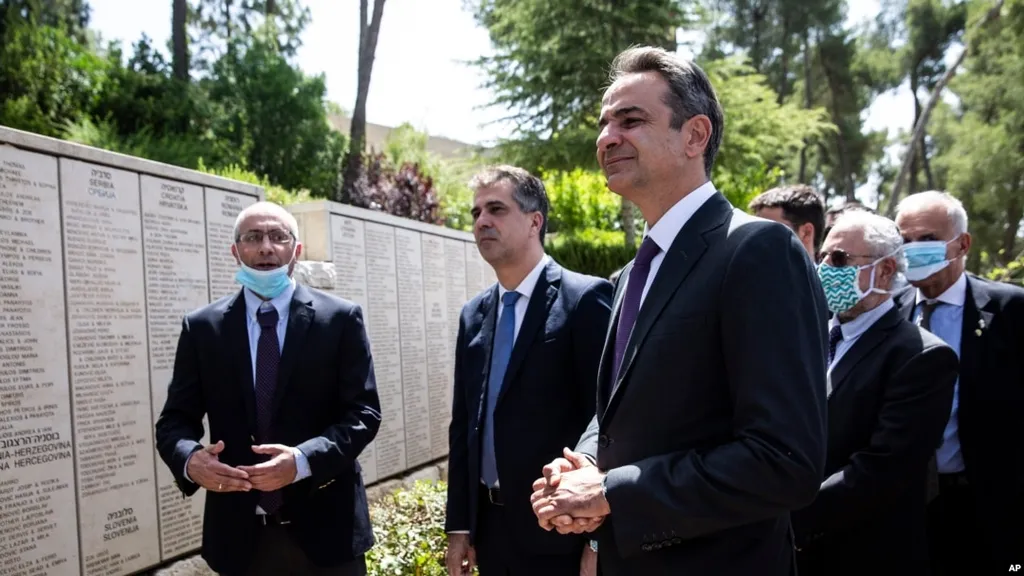
Greece’s ambitious €25-28 billion military modernization program, spanning from 2025 to 2036, is not just about acquiring new fighter jets and missile systems. It signifies a profound strategic shift in the Eastern Mediterranean, positioning Israel as Athens’ indispensable partner. This initiative, the most extensive defense overhaul in Greece’s modern history, aims to transform the Hellenic Armed Forces into one of Europe’s most technologically advanced militaries. Israel’s defense industries, renowned for their operational expertise, are playing a pivotal role in reshaping Greece’s security posture.
The program, which allocates €2-2.5 billion annually, includes key acquisitions such as 20 F-35 fighter jets, advanced drone and cyber systems, and the development of Achilles’ Shield—a multi-layered air, missile, and anti-drone defense network. Central to this initiative is the integration of Israeli defense systems, which will be key players in bolstering Greece’s deterrence capabilities. The Achilles’ Shield program also seeks to strengthen Greece’s domestic defense industry, ensuring long-term sustainability and reducing reliance on imports.
Turkey, meanwhile, has made defense autonomy a national priority, aiming to meet nearly all of its military needs domestically by 2030. After being excluded from the F-35 program, Ankara has accelerated its flagship projects, including the KAAN fifth-generation fighter jet, now in prototype stage, and the Altay main battle tank, which began deliveries in 2025. At sea, the Turkish Navy is pursuing a modernization plan that includes new submarines and air-defense destroyers. In the missile domain, Ankara is aggressively developing long-range and hypersonic systems. The Tayfun Block-4 ballistic missile, capable of reaching speeds above Mach 5 with a range of 800 km, successfully completed a test last week, with mass production planned by 2026.
Turkey’s $6.5 billion Steel Dome program, a multi-layered air defense network designed to rival Israel’s Iron Dome and Greece’s Achilles’ Shield, aims to provide protection against aircraft, drones, and ballistic threats. President Recep Tayyip Erdogan claimed that the Steel Dome “will instill confidence in friends and fear in enemies.”
For Greece, these developments represent a direct challenge across the Aegean and have accelerated its modernization timeline. The Achilles’ Shield program, announced in 2025, includes a $3.5 billion investment in Israeli-made Barak MX, David’s Sling, and Spyder systems, developed by Rafael Advanced Defense Systems and IAI-Israel Aerospace Industries. These acquisitions will replace aging American and Russian platforms, giving Greece one of Europe’s most sophisticated air defense networks. On the ground, Athens has approved the purchase of 36 Elbit Systems’ PULS rocket artillery launchers, providing long-range precision strike capability that directly counters Turkey’s expanding missile arsenal.
Israel’s LORA ballistic missile system, with a range of up to 400 km, was showcased in Athens earlier this year and is under active consideration. If acquired, it would extend Greece’s strike reach and serve as a deterrent against Turkey’s growing missile forces. The partnership extends beyond hardware, with joint naval and air exercises involving Greek frigates, submarines, and Israeli Sa’ar corvettes. These drills underscore a shared commitment to securing the Eastern Mediterranean, where both nations face regional instability and assertive Turkish policies.
For Greece, collaboration with Israel strengthens its NATO role while signaling alignment with regional democracies. For Israel, deepening ties with Athens enhances its strategic depth in the Mediterranean and opens new markets for its defense industry. Israeli defense firms are not merely selling equipment; they are embedding themselves in Greece’s defense architecture, providing tailored solutions designed to meet Greece’s unique threat environment.
The partnership also carries economic weight. Greece’s defense spending, already among the highest in NATO relative to GDP, is being channeled into projects that will strengthen its domestic industry through Israeli collaboration. Politically, the alliance underscores a broader realignment in the region, with Greece, Israel, and Cyprus increasingly coordinating on energy, security, and diplomacy.
The geopolitical context cannot be ignored. Both Greece and Israel face assertive neighbors and volatile regional dynamics. Athens’ modernization is driven in part by tensions with Ankara over maritime boundaries and energy exploration. Jerusalem, meanwhile, continues to navigate instability in the Middle East. The result is a regional arms race that is increasingly defined by parallel modernization programs. Turkey’s emphasis on indigenous production contrasts with Greece’s reliance on partnerships, particularly with Israel and France, but the strategic logic is the same: to secure deterrence and ensure freedom of action in a contested region.