
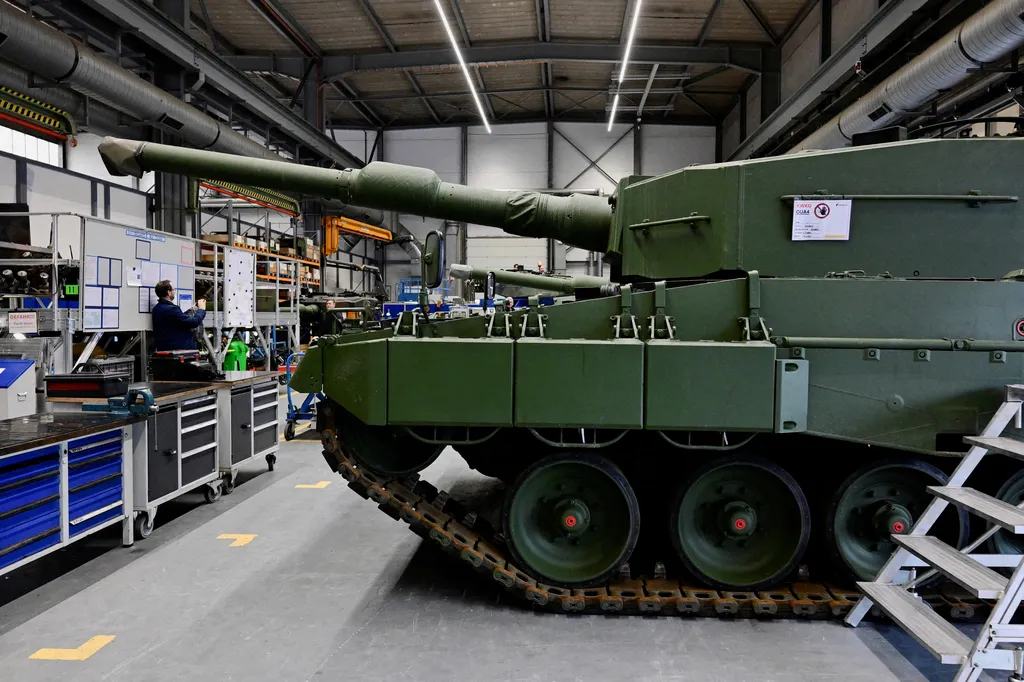
Germany’s defence industry is at a crossroads as the country accelerates its rearmament efforts, with major players drawing battle lines over where hundreds of billions of euros in new spending should be directed. Traditional manufacturers are advocating for investment in heavy weaponry, while emerging technology firms are pushing for modern systems such as AI-enabled drones. This debate is intensifying as Chancellor Friedrich Merz pledges to build Europe’s strongest conventional army, a commitment that has sparked a race across Europe to bolster defence capabilities.
The urgency of this rearmament drive was ignited by Russia’s full-scale invasion of Ukraine in 2022 and has been further fuelled by pressure from US President Donald Trump for NATO allies to increase defence spending. There is also growing concern about Washington’s long-term commitment to Europe’s security, adding to the imperative for European nations to strengthen their own defences.
At the heart of the debate is whether Germany should prioritise traditional military hardware or invest in cutting-edge, cost-effective technologies. A new generation of German defence technology start-ups argues that the war in Ukraine—fought increasingly with unmanned aerial vehicles—demonstrates the critical role of relatively inexpensive, mass-producible equipment like AI-powered drones. They criticise the current spending patterns, which have largely focused on costly, time-tested weapons such as tanks and armoured vehicles, which are vulnerable to newer, cheaper airborne systems.
“There has clearly been an overly strong focus on traditional platforms,” Gundbert Scherf, co-founder and executive at German defence technology company Helsing, told AFP. “Spending patterns have to change as the world around us changes.”
Helsing, a Munich-based company founded in 2021, supplies strike drones to the Ukrainian military and has seen a shift in attitudes. Backed by Spotify founder Daniel Ek’s investment firm and valued at around €12 billion, Helsing recently conducted successful tests with the German armed forces. “I’m hoping we’ll see a move from a model where 99 percent of spending goes to traditional systems and one percent to autonomous ones, towards a far more balanced approach,” Scherf said.
Similar cautious optimism was voiced by Stark, a start-up founded just 18 months ago that has also tested its drones with the Bundeswehr. Josef Kranawetvogl, a senior executive at the firm—among whose investors is US tech billionaire Peter Thiel—said public procurement in Germany was changing in a positive direction. However, he stressed the need for faster and more decisive action, warning that Europe excels at drafting strategic papers but lags behind in execution.
On the other side of the debate stands Rheinmetall, Germany’s largest weapons manufacturer and a key supplier of military vehicles and ammunition. Chief executive Armin Papperger acknowledges the growing importance of drones, which the company also produces, but insists they are only one part of a broader arsenal. “Without armoured vehicles, defending a country or repelling an aggressor in the event of an invasion would not be possible,” Papperger has said. In a NATO-involved war, he added, the conflict would look very different from Ukraine, with drones playing a less dominant role. Rheinmetall is currently valued at around €70 billion.
Drones also feature in government planning. Defence Minister Boris Pistorius said in October that Germany intends to invest around €10 billion in the technology over the coming years. However, there are signs that traditional systems remain the priority. Politico reported that the government has drawn up a list of desired arms purchases worth €377 billion, with a significant share earmarked for established defence giants. A defence ministry spokesperson declined to comment on the report but noted that drones have long been part of military operations, while tanks, combat aircraft and armoured personnel carriers will continue to be needed alongside unmanned systems.
Germany’s rearmament marks a profound shift for a country shaped by deep pacifist traditions following World War II. Concerns persist, however, that the process is moving too slowly and risks being misdirected. British historian Niall Ferguson and Moritz Schularick, president of the Kiel Institute for the World Economy, recently warned that decision-makers are focusing too heavily on the weapons of the last war rather than those of the next.
As Germany navigates this complex landscape, the debate over where to direct its defence investments will shape the future of its military capabilities and its role in European security. The choices made today will determine whether Germany is prepared for the conflicts of tomorrow.