
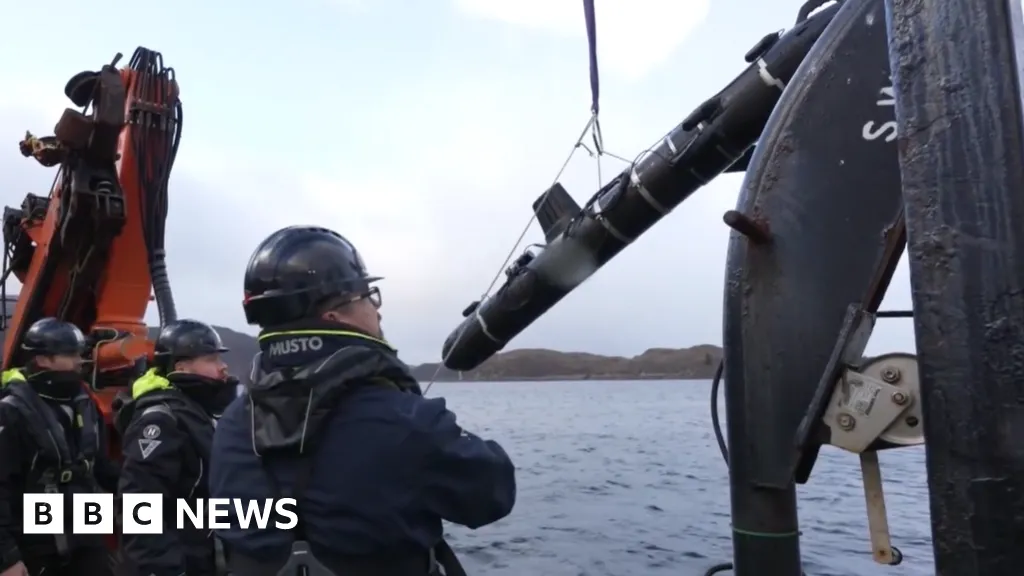
The UK is taking decisive steps to bolster its defences against the escalating threat of Russian underwater activities in the North Atlantic. Defence Secretary John Healey recently unveiled the groundbreaking Atlantic Bastion programme during a visit to HM Naval Base Portsmouth. This initiative, part of the Strategic Defence Review, aims to revolutionise the Royal Navy’s submarine-hunting capabilities and ensure the security of critical undersea infrastructure.
Atlantic Bastion represents a significant leap forward in naval warfare technology. The programme integrates autonomous surface and underwater vessels, advanced digital infrastructure, and state-of-the-art warships and patrol aircraft. This hybrid approach is designed to counter the resurgence of Russian submarine activity, including the notorious spy ship Yantar, which has been operating near UK waters.
The UK Defence Intelligence has identified that Russia is modernising its fleet to target critical undersea cables and pipelines. In response, Atlantic Bastion will create an advanced hybrid naval force capable of detecting, tracking, and acting against adversaries with unprecedented effectiveness across vast ocean areas.
The programme has already garnered substantial interest from the industry, with a combined investment of £14 million from the Ministry of Defence and private sector partners this year. Twenty-six firms from the UK and Europe have submitted proposals for developing anti-submarine sensor technology, and 20 companies are already showcasing technology demonstrators. The public investment has been matched by private investment at a 4:1 ratio, highlighting the industry’s commitment to the project.
The next phase of development and testing will see successful companies advance their concepts to frontline capabilities, with deployments expected in the water next year. This rapid progress underscores the UK defence industry’s readiness to support the government’s vision for a hybrid navy.
Defence Secretary John Healey emphasised the urgency of addressing new underwater threats: “People should be in no doubt of the new threats facing the UK and our allies under the sea, where adversaries are targeting infrastructure that is so critical to our way of life. This new era of threat demands a new era for defence, and we must rapidly innovate at a wartime pace to maintain the battlefield edge as we deliver on the Strategic Defence Review. Our pioneering Atlantic Bastion programme is a blueprint for the future of the Royal Navy. It combines the latest autonomous and AI technologies with world-class warships and aircraft to create a highly advanced hybrid fighting force to detect, deter, and defeat those who threaten us.”
First Sea Lord General Sir Gwyn Jenkins, speaking at the International Sea Power Conference in London, hailed Atlantic Bastion as a pioneering new era of maritime warfare. He highlighted the programme’s blend of skilled crews with autonomous platforms and artificial intelligence, positioning Britain as a global leader in autonomous naval warfare. “We are a Navy that thrives when it is allowed to adapt. To evolve. We have never stood still – because the threats never do. The SDR identified the maritime domain as increasingly vulnerable – and that maritime security is a strategic imperative for the UK. It is time to act. This begins with Atlantic Bastion – our bold new approach to secure the underwater battlespace against a modernising Russia. Our commitment to Alliance. And it is happening now. A revolutionary underwater network is taking shape – from the Mid-Atlantic Ridge to the Norwegian Sea. More autonomous, more resilient, more lethal – and British built. We’ve already made rapid and significant progress with delivering Atlantic Bastion. A force that keeps us secure at home and strong abroad.”
Atlantic Bastion will connect ships, submarines, aircraft, and unmanned vessels through AI-powered acoustic detection technology, forming a digital targeting web. This networked system will enable faster battlefield decisions and enhance the UK’s ability to counter enemy threats.
The programme also highlights the UK’s leadership in transforming hybrid navies, a sector worth £350 billion globally. This initiative could create thousands of skilled British jobs, demonstrating defence as an engine for economic growth. The programme represents a truly integrated, multi-domain approach, combining Royal Navy and Royal Air Force assets, Strategic Command digital infrastructure, and commercial partners.
Dr Rich Drake, Managing Director of Anduril UK, stated: “The government has called upon industry to create the modern warfighter. We have designed Seabed Sentry in the UK in partnership with other British companies to deliver for our Armed Forces and protect allied waters from increasingly hostile actors. We are investing in British talent, in British technology and in Britain’s tomorrow. Anduril UK stands ready to defend British interests.”
Scott Jamieson, Managing Director of BAE Systems Defence Solutions, added: “Autonomy represents a transformative opportunity to redefine how operations are conducted above and below the waves. That is exactly why we developed Herne, the UK’s first autonomous extra large submarine for military use and its fully autonomous military control system, Nautomate. They deliver enhanced tactical flexibility, enable data-driven mission decisions and scale operations in ways that were previously unimaginable.”
Amelia Gould, General