
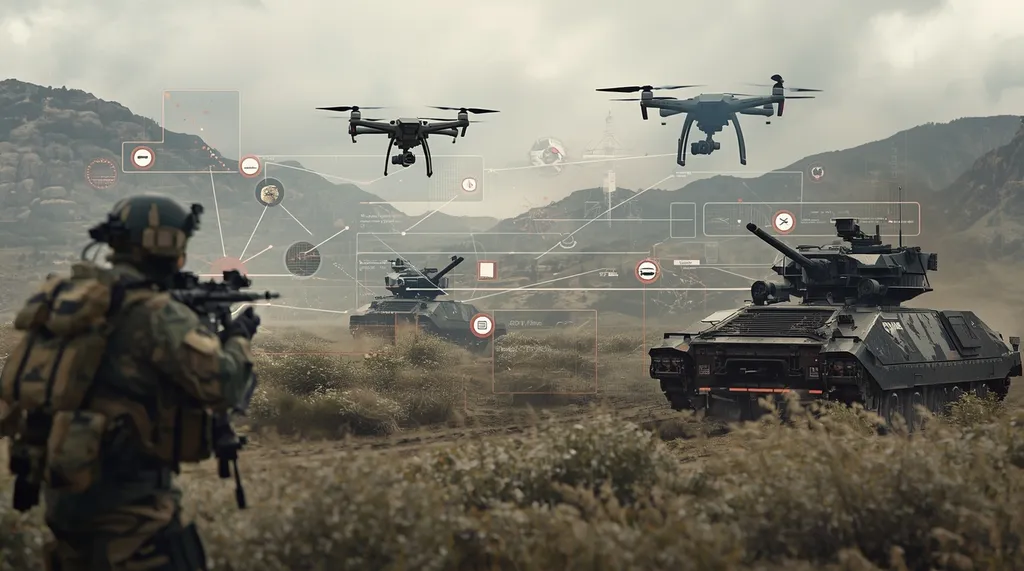
The British Army and other European militaries are undergoing a technological revolution, driven by the Russian threat and operational lessons from the war in Ukraine. This transformation, highlighted at the Royal United Services Institute’s (RUSI) annual Military Technology Conference in London, marks a sharp transition from hardware-centric systems to AI-driven and autonomous platforms. The strategic goal is clear: by 2035, most combat platforms will be unmanned.
The British Strategic Defense Review (SDR) outlines an ambitious vision for the future of the British military, including doubling the defense budget and restructuring the force. This shift is not merely evolutionary but a revolutionary “tsunami” that will reshape the battlefield. The SDR aims for a force composition of 20% manned platforms, 40% unmanned platforms, and 40% unmanned strike systems, fundamentally altering battalion structures, command chains, and operational concepts.
AI is at the heart of this transformation, evolving from an auxiliary tool to a core component of future force design. Its principal military uses include rapid intelligence processing, real-time sensor fusion, target classification, decision support, autonomous navigation, and complex fire network management. According to the conference’s keynote speaker, AI will soon become an operational force multiplier, enhancing lethality and survivability.
The war in Ukraine has been a primary source of insight for these military transformations. Key lessons include the importance of cheap and smart munitions, such as FPV drones and unmanned surface vessels, which have demonstrated high lethality at low cost. The conflict has also highlighted the value of multi-channel information fusion, where real-time sensor data processing creates a high-quality operational picture, increasing responsiveness and lethality.
Russia, despite being portrayed as an aggressive state, has shown remarkable rapid technological adaptation. Notable advances include electronic warfare, communications and GPS disruption, mass drone-swarm attacks, and basic AI for data processing. While Russia lags behind the West in development, it excels in rapid battlefield implementation.
The UK is already advancing large-scale AI programs, as evidenced by several ongoing projects. The Digital Targeting Web, for instance, is an AI-driven network linking sensors, observers, and strike assets to reduce strike-cycle times from hours to minutes, with a budget of over £1 billion and a timeline set for 2027. Other projects include Recce-Strike/ASGARD, a long-range AI-based target-classification system; SCEPTER, an AI infrastructure for C2 systems; Loyal Wingman, an autonomous combat UAV; THESEUS, an autonomous logistics system; SPOT/V60, AI-based quadruped robots for urban navigation; and PANORAMA, an AI system generating a synchronized operational picture for tactical headquarters.
However, the path from vision to deployed systems is fraught with challenges, often referred to as the “Valley of Death” of innovation. Major obstacles include excessive bureaucracy, outdated procurement processes, institutional conservatism, and pressure from established defense companies. The military world’s approach to innovation differs fundamentally from the civilian sector, where multiple ideas compete, and the market selects the winners. In contrast, military innovation often relies on a single committee’s decision, stifling private investment and preserving a rigid defense-industrial ecosystem.
Additionally, civilian AI is not tailored for combat environments, leading to gaps between civilian AI giants and military needs. Challenges include insufficient combat data for training, systems that cannot fully explain their decisions, real-time processing requirements, reliability and security issues, and the inability of systems to withstand extreme field conditions.
Legal and ethical considerations further complicate the integration of autonomous systems. Tensions exist between operational approaches that seek to retain human control and legal warnings against systems that could act “beyond human control.” Legal scholars demand involvement from the outset of development, which could slow down innovation and complicate processes.
As Britain undergoes this profound conceptual and operational shift, its success will depend on overcoming structural barriers, accelerating innovation, and transforming advanced technological capabilities into effective military power within a short time frame. The present decade is characterized by deep changes in the nature of modern warfare, and Europe, including the United Kingdom, must adapt to face large-scale conventional threats with renewed military buildup and technological advancements.