
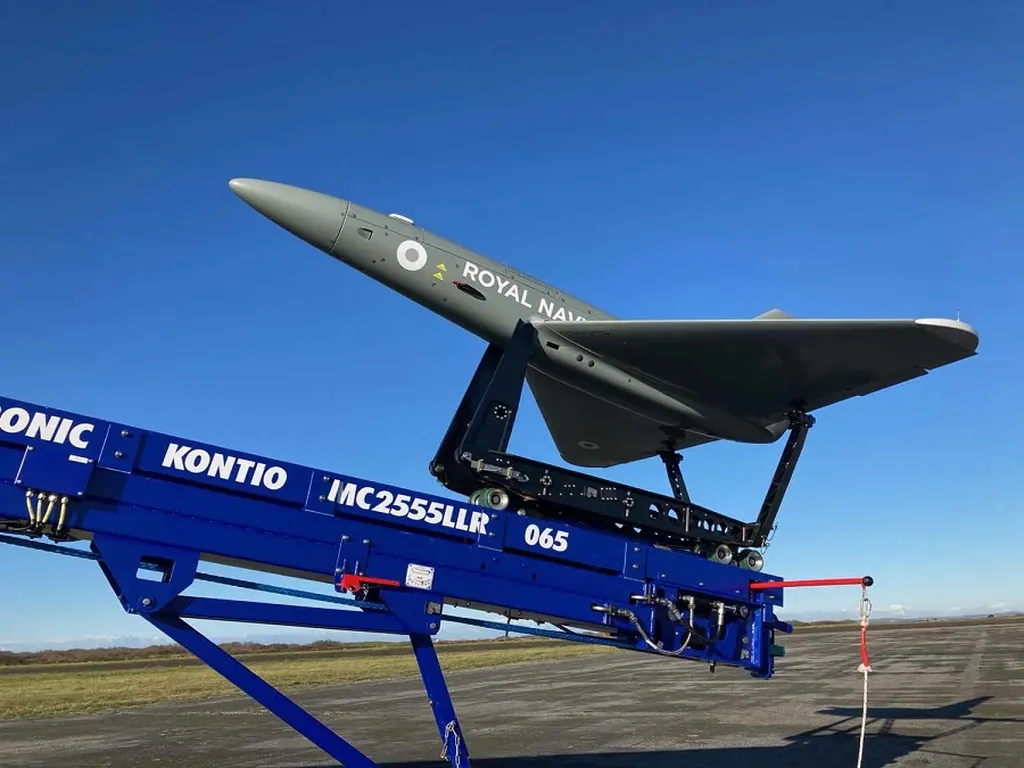
The Royal Navy has retired its Banshee Jet 80+ aerial target drones after a two-year project that explored the potential of lightweight, fixed-wing, carrier-borne, crewless and autonomous systems. The drones, designed and developed by UK-based defence technology company QinetiQ, were used to simulate the threat of various manned and unmanned systems, including fighter jets, unmanned aerial vehicles (UAVs) and cruise missiles.
The Banshee Jet 80+ was launched from the flight deck of the Royal Navy’s Queen Elizabeth-class aircraft carrier HMS Prince of Wales in September 2021 as part of Project Vampire. The demonstrations were conducted to develop the skills needed to safely operate and maintain the drone fleet, with a new flight established within 700X Naval Air Squadron (NAS) based at Royal Naval Air Station Culdrose.
The Banshee Jet 80+ has a length of between 2.85 metres (m) and 2.95m, depending on configuration, an overall height of 0.78m, and a wingspan of 2.49m. It is an improved version of the Banshee Jet 80 aerial target, which was introduced in 2014. The drone is suitable for testing land and sea-based weaponry and can be used as a target for surface-to-air and air-to-air weapon systems, as well as guns and cannon systems. It also supports autonomous operations and can be recovered using a parachute.
When equipped with the patented Hot Nose, the target offers infrared emissions to the front and sides across Bands I, II and III. At the same time, its jet engines generate an authentic rearward infrared signature. The performance of the aerial target drone can be changed using different plug-in modules.
The Banshee family of targets is mainly used during the operational trials of weapons systems. It includes the Banshee Jet 40, Banshee Jet 80, Banshee Whirlwind, Banshee NG and Banshee Jet 80+. The Banshee Jet 80+ can carry a range of payloads, including up to eight smoke tracking flares, up to 16 infrared (IR) tracking flares, IR and chaff decoy dispensing pods, Luneberg lenses, and an identification, friend or foe (IFF) transponder system capable of operating in modes A and C. It can also be fitted with a radar altimeter, active radar augmenters, sea-skimming module, active radar homing emulator (ARHE), and acoustic and doppler radar with miss distance indicator (MDI).
The target drone can also be equipped with the Hot Nose black-body IR enhancement system for a forward and side-looking IR source. The Hot Nose, which is a patented technology of the company, provides a proven capability against a range of missiles, including Mistral, Stinger, Igla, Aim 9 and Strella. Furthermore, the Banshee Jet 80+ can deploy the Rattler Supersonic Target platform as an ejectable payload, broadening its configuration possibilities and strengthening its suitability for a wide range of international customer needs.
The Banshee drone is integrated with QinetiQ’s combined autopilot and surveillance payload avionics (CASPA), which contributes to its stabilisation. The avionics system includes a three-axis inertial measurement unit (IMU) and a digital autopilot. The on-board integrated global positioning system (GPS), digital telemetry systems and autonomous waypoint navigation provide tracking and telemetry capabilities.
The aerial target drone is powered by twin gas-turbine engines, which provide a thrust equivalent to 45kg each. The total thrust of 90kg gives the drone an airspeed of up to 200m/s (720kmh). The launch speed of the aerial target is approximately 45m/s (162kmh) and varies with the payload. The drone can achieve an operating range of more than 100km and maximum altitude of 9,144m. It can provide a controlled sea-skimming flight at a minimum altitude of 5m. The endurance is more than 45 minutes in mixed throttle settings, the same as that of the single-engine configuration, which is achieved by using an auxiliary fuel tank.
US-based technology company Trideum provided the aerial target drones to the US Department of Defense (DoD) ranges under a contract awarded in July 2019. Trideum and QinetiQ are providing engineering, technical, training and flight services for the Banshee Jet 80+. They are also responsible for the integration of the target drone into the US Army’s Ground Aerial Target Control System (AGATCS