
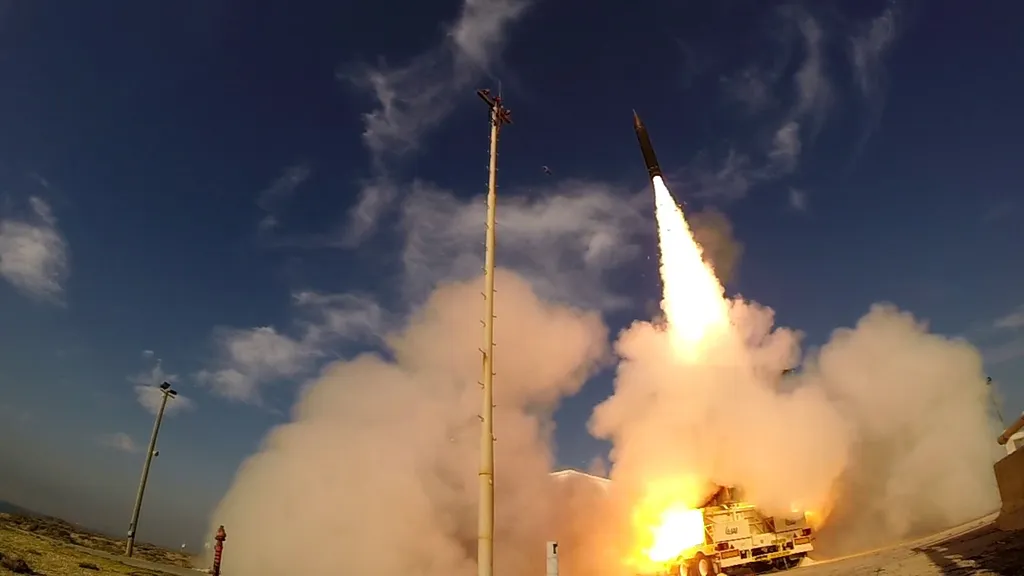
Germany has formally begun commissioning its new Arrow 3 missile defence system, turning the Holzdorf air base south of Berlin into the heart of a future long-range protective shield for much of Europe. On 3 December 2025, the Bundeswehr declared the “initial operational capability” of the first Arrow 3 battery at Schönewalde/Holzdorf, a site straddling the border between Brandenburg and Saxony-Anhalt. This step marks more than just a technical upgrade; it is Europe’s first exo-atmospheric ballistic missile interceptor on duty and the first deployment of Arrow 3 outside Israel. It also represents a key building block in Germany’s ambition to become a central provider of air and missile defence within NATO and the European Sky Shield Initiative.
At midday on 3 December, senior military leaders, including Inspector General Carsten Breuer and Air Force Inspector Lieutenant General Holger Neumann, gathered at Fliegerhorst Holzdorf to declare what NATO calls Initial Operational Capability (IOC) for Arrow 3. IOC does not mean the system is fully deployed, but it signifies that the first radar, launchers with ready missiles, and trained personnel are in place and able to provide a limited protective function against long-range ballistic missiles. Holzdorf/Schönewalde is the first of three planned Arrow 3 locations in Germany, with additional batteries slated for northern Germany (Schleswig-Holstein) and Bavaria by the end of the decade, creating a north-south belt of long-range missile defence coverage.
The choice of Holzdorf is strategic: roughly 70–80 kilometres south of Berlin, close to the intersection of three federal states (Brandenburg, Saxony-Anhalt, and Saxony), and already home to important Luftwaffe helicopter units. Arrow 3 is an exo-atmospheric anti-ballistic missile system jointly developed by Israel Aerospace Industries (IAI) and the United States, with Boeing as a major industrial partner. According to public technical data and German government briefings, Arrow 3 intercepts ballistic missiles outside the Earth’s atmosphere at altitudes above 100 kilometres, can engage threats launched from up to around 2,400 kilometres away, and uses a “hit-to-kill” warhead that destroys its target through sheer impact energy. It is optimized to counter missiles that may carry weapons of mass destruction, breaking them up high enough that any remaining material burns up as it falls back through the atmosphere.
Arrow 3 forms the top layer of a multi-tiered defence architecture, with IRIS-T SLM and Patriot batteries handling aircraft, cruise missiles, and shorter-range ballistic threats in the lower and mid-altitudes. This layered approach is central to both NATO’s ballistic missile defence planning and Germany’s own concept of national “air defence of the future.” The Arrow 3 purchase is one of the largest defence projects in modern German history, valued at roughly €3.6–4 billion and financed from the €100-billion special fund created after Russia’s full-scale invasion of Ukraine. For Israel, the deal is widely described as the largest defence export in the country’s history; for Germany, Arrow 3 offers a capability it simply did not have before: the ability to detect and intercept ballistic missiles thousands of kilometres away, before they ever enter German airspace.
German Defence Minister Boris Pistorius argues that Arrow 3 provides early warning and protection for the population and critical infrastructure from long-range missiles, is a “strategic capability” unique among European partners, and strengthens both Germany’s central role in NATO and the European pillar of the alliance. The timing is no accident. Russia’s missile and drone attacks against Ukraine, and repeated Western warnings about Moscow’s modernizing arsenal of long-range weapons, have dramatically exposed Europe’s vulnerabilities. NATO planners now estimate that European air-defence capacity may need to expand by several hundred percent to meet future threat scenarios.
For the region around Holzdorf and Schönewalde, Arrow 3 is as much an economic and structural policy story as a military one. The air base—once repeatedly threatened with closure—is being transformed into the largest Luftwaffe site in eastern Germany. Holzdorf is becoming a central hub for Germany’s air force, combining missile defence and air transport. Alongside Arrow 3, 47 of 60 planned CH-47F Chinook heavy transport helicopters will be stationed there later this decade. Military investment at the base is expected to reach around €700 million, with Brandenburg channeling roughly €100 million in structural funds into local infrastructure—roads, rail links, childcare, schools, and other public services. The number of soldiers and civilian employees is set to rise from about 2,000 today to between 2,500 and 3,000, with an estimated