
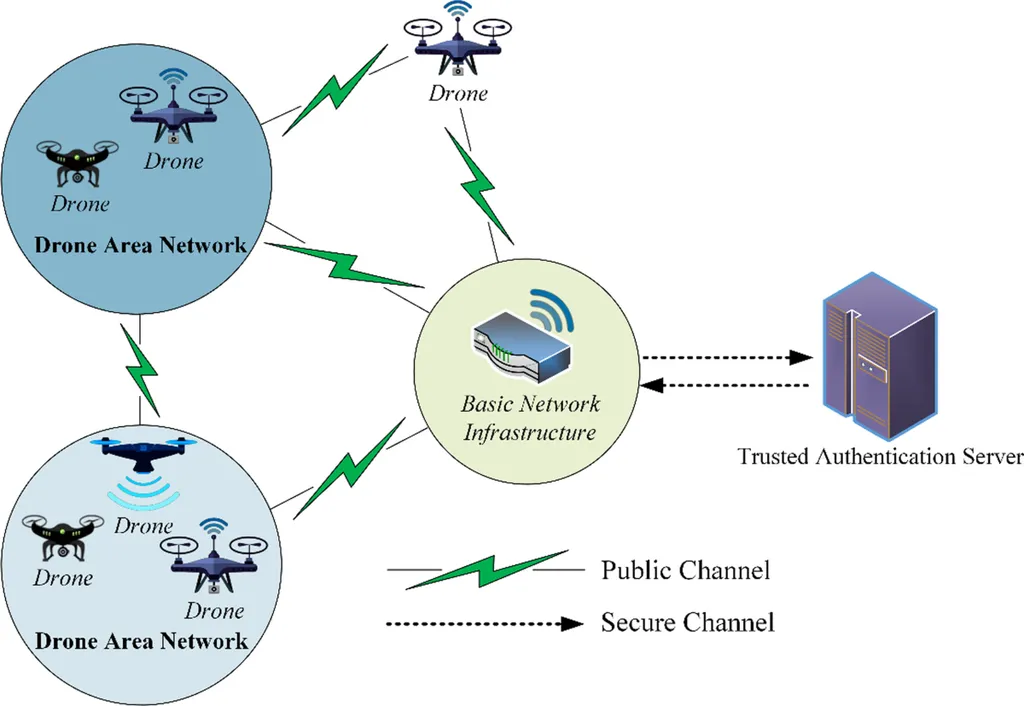
In an era where Unmanned Aircraft Systems (UAS), or drones, are becoming increasingly prevalent, the need for robust security and accountability mechanisms has never been more critical. Recent sightings of drones over sensitive locations—including U.S. military facilities, suburban neighborhoods, and commercial airports—have heightened concerns about unauthorized and potentially malicious drone activity. In response, the Federal Aviation Administration (FAA) has mandated that drones broadcast their location, operator’s location, and identity in real-time through a system known as Remote ID. However, the current standards for Remote ID lack robust authentication mechanisms, leaving the system vulnerable to spoofing, relay, and replay attacks. These vulnerabilities could undermine surveillance efforts and disrupt future UAS-to-UAS coordination, posing significant risks to both national security and public safety.
To address these challenges, researchers Jason Veara, Manav Jain, Kyle Moy, and Aanjhan Ranganathan have developed TBRD, a practical system designed to authenticate Remote ID messages effectively. TBRD, which stands for TESLA Authenticated UAS Broadcast Remote ID, leverages the TESLA protocol and mobile device Trusted Execution Environments (TEEs) to create a lightweight, mission-scoped authentication system. This approach ensures that Remote ID messages are not only authenticated but also computationally efficient and require minimal communication overhead. The system is designed to align seamlessly with existing standards and UAS capabilities, making it a viable solution for enhancing the security of drone operations.
The TESLA protocol, a well-established method for authenticating broadcast messages, forms the backbone of TBRD. By integrating TESLA with TEEs, TBRD ensures that the authentication process is both secure and efficient. TEEs provide a secure environment for executing code, protecting it from tampering and ensuring the integrity of the authentication process. This combination allows TBRD to offer a robust defense against potential attacks while maintaining low computational and communication overhead.
To evaluate the performance of TBRD, the researchers conducted a series of tests using an FAA-requirements-compatible proof-of-concept implementation. The results demonstrated a 50% reduction in authentication overhead compared to digital signatures and a 100x reduction in computation time. These significant improvements highlight the efficiency and practicality of TBRD, making it a promising solution for real-world applications. Additionally, the researchers simulated a 4-drone swarm mission scenario to assess TBRD’s security guarantees under adversarial conditions. The results confirmed that TBRD can effectively authenticate Remote ID messages, even in the presence of potential threats.
The implications of TBRD extend beyond regulatory compliance. By providing a scalable, standards-compliant message authentication system, TBRD can enhance the security and reliability of UAS operations in various domains. For instance, in military applications, TBRD can ensure that drone communications are secure and tamper-proof, preventing adversaries from disrupting critical missions. In commercial and civilian applications, TBRD can help build public trust in drone technology by ensuring that drones operate safely and responsibly.
As the use of drones continues to grow, the need for robust security measures becomes increasingly urgent. TBRD offers a practical and effective solution to the challenges posed by the current Remote ID standards. By leveraging the TESLA protocol and mobile device TEEs, TBRD provides a lightweight, efficient, and secure authentication system that can be integrated into existing infrastructures. The research conducted by Veara, Jain, Moy, and Ranganathan demonstrates the potential of TBRD to enhance the security of UAS operations, paving the way for safer and more reliable drone technology in the future. Read the original research paper here.