
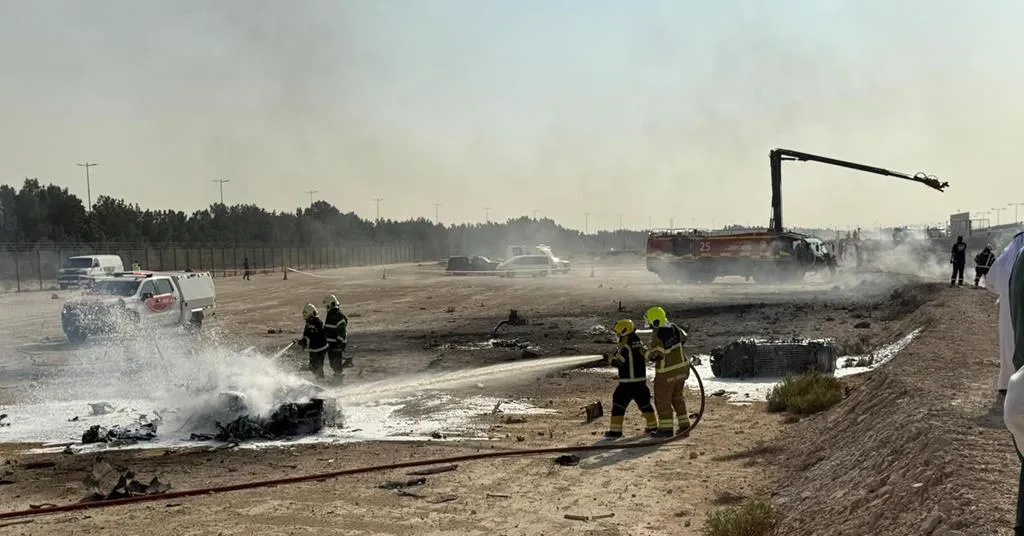
The crash of India’s Tejas fighter jet at the Dubai Airshow has cast a shadow over the nation’s ambitions to export its homegrown defence technology, analysts say. The incident, which occurred in front of global arms buyers, has left the Tejas reliant on domestic military orders to sustain its role as a showcase of India’s advanced engineering capabilities.
The cause of Friday’s crash remains unknown, but it has overshadowed India’s efforts to establish the Tejas on the international stage after four decades of development. Experts mourn the loss of Wing Commander Namansh Syal, who died in the crash, and acknowledge the setback it represents for India’s defence export drive.
“The imagery is brutal,” said Douglas A. Birkey, executive director of the U.S.-based Mitchell Institute for Aerospace Studies. “A crash sends quite the opposite signal: a dramatic failure.” However, Birkey believes the Tejas will likely regain momentum despite the negative publicity.
The Dubai Airshow, the world’s third-largest after Paris and Britain’s Farnborough, is a critical platform for nations and industries to showcase their achievements. Accidents at such events are rare, with the last major incident occurring in 1999 when a Russian Sukhoi Su-30 crashed at the Paris Airshow. Despite the setback, India went on to place orders for both the Su-30 and the Soviet MiG-29, which also crashed at the Paris Airshow a decade earlier.
Fighter sales are driven by high-order political realities, which supersede a one-off incident, Birkey noted. The Tejas programme began in the 1980s as India sought to replace its vintage Soviet-origin MiG-21s. The state-owned Hindustan Aeronautics Ltd (HAL) has 180 of the advanced Mk-1A variant on order domestically but faces engine supply chain issues at GE Aerospace.
A former HAL executive, who left the company recently, said the crash in Dubai “rules out exports for now.” The focus for the coming years would be on boosting production of the fighter for domestic use, the executive added, requesting anonymity.
The Indian Air Force is concerned about its shrinking fighter squadrons, which have fallen to 29 from an approved strength of 42. Early variants of the MiG-29, Anglo-French Jaguar, and French Mirage 2000 are set to retire in the coming years, and the Tejas was supposed to be their replacement. However, production issues have hampered its deployment.
As an alternative, India is considering off-the-shelf purchases to fill immediate gaps, with options including more French Rafales. India is also weighing competing offers from the U.S. and Russia for 5th-generation F-35 and Su-57 fighters, two advanced models also rarely sharing a stage in Dubai this week.
India has for years been among the world’s biggest arms importers but has increasingly projected the Tejas as an example of self-reliance. Prime Minister Narendra Modi took a sortie in the fighter in November 2023, underscoring the government’s commitment to the programme.
The jet’s long-term significance is “likely to lie less in sales abroad than in the industrial and technological base it creates for India’s future combat-aircraft programmes,” said Walter Ladwig, an associate fellow at the Royal United Services Institute in London.
The crash at the Dubai Airshow has highlighted the challenges India faces in establishing the Tejas as a global competitor. However, the incident also underscores the resilience and determination of the Indian defence industry. As the nation continues to invest in advanced manufacturing and innovation, the Tejas programme remains a critical component of India’s military modernisation and strategic autonomy.
In the meantime, regional rivalries played out at the show, with Pakistan disclosing the signing of a provisional agreement to supply its JF-17 Thunder Block III fighter, co-developed with China. The JF-17 was flanked by arms, including the PL-15E, a family of Chinese missiles that U.S. and Indian officials say brought down at least one French Rafale used by India during an aerial battle with Pakistan in May.
The Tejas, which was not actively used in the four-day conflict in May, reflects India’s cautious approach to its deployment. The crash at the Dubai Airshow serves as a reminder of the risks and challenges inherent in the development and demonstration of advanced military technology. As India navigates these complexities, the Tejas programme remains a testament to the nation’s ambition and determination to establish itself as a global leader in defence innovation.