
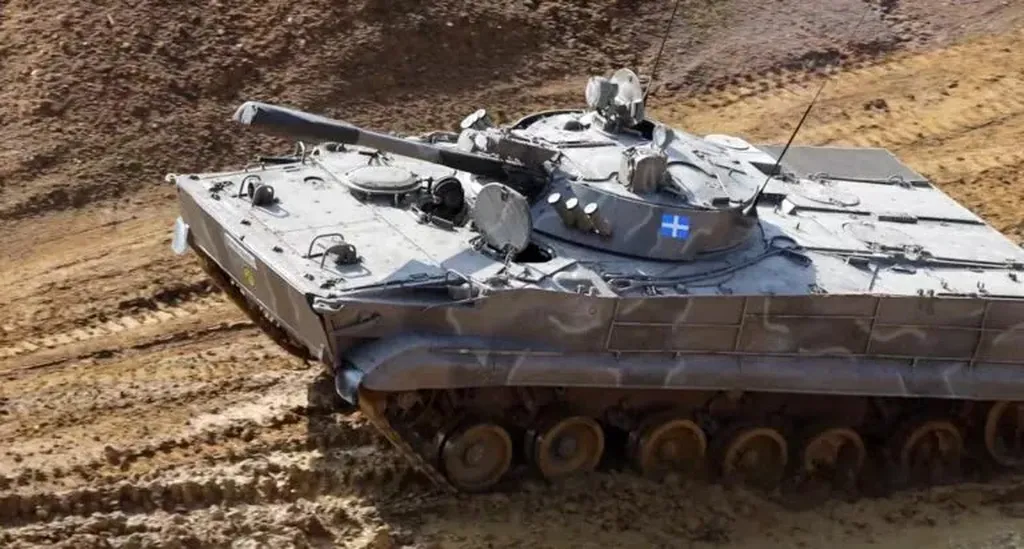
During an international conference on Defence, Technology, and the National Guard held in Nicosia last week, representatives from the Israeli defence company Rafael presented a comprehensive upgrade proposal for BMP-3 infantry fighting vehicles. This proposal is particularly relevant to the Cyprus National Guard, which operates the same type of vehicles. The Israeli presentation, however, was not specifically tailored to the Cypriot fleet but was part of a broader showcase of Rafael’s capabilities and its approach to modern battlefield requirements.
The core of the proposed upgrade involves the complete removal of the original 100 mm gun turret and its replacement with a remotely operated weapon station. This station would be armed with a 30 mm automatic cannon and Israeli-made SPIKE anti-tank guided missiles—the same missiles recently acquired by the Cyprus National Guard from Rafael. This upgrade would significantly modernise vehicles that were built to 1987 specifications, bringing them in line with contemporary military standards.
The Cyprus National Guard currently operates 43 BMP-3s, which were purchased in the mid-1990s for the 28th Armoured Battalion at a total cost of $68 million. According to sources within the armed forces, the proposal is not currently under active consideration by the General Staff (ΓΕΕΦ), although it cannot be ruled out at a later stage. The strong bilateral relations between the Republic of Cyprus and Israel, combined with recent arms transactions, keep the door open for such cooperation. It is worth recalling that Cyprus had been in talks with Israel regarding the possible purchase of Merkava main battle tanks; however, those negotiations were frozen following the events of 7 October 2023 and the subsequent war.
Growing Concerns Over Russian-Made Systems
The presence of Russian-made weapon systems in the National Guard’s inventory is causing serious headaches for both the General Staff and the Ministry of Defence, particularly regarding maintenance, spare parts supply, and ammunition procurement. While recent discussions have focused mainly on the T-80 main battle tanks, the Russian BMP-3 infantry fighting vehicle is now also part of the equation, as it forms a key component of the operational capability of the XX Armoured Brigade.
Cyprus can no longer rely with confidence on its Russian weapon systems for a combination of operational and geopolitical reasons. Due to sanctions prohibiting transactions with Russian defence companies, the supply of spare parts has been halted, while logistical and technical support from Moscow has become difficult—if not impossible. The same problem affects ammunition procurement, since Western munitions are not compatible with Soviet-era systems. Under these circumstances, the Russian systems create a lack of standardisation within the fleet. In the specific case of the BMP-3, it is the only vehicle in the National Guard that uses 100 mm ammunition.
Both the Ministry of Defence and the General Staff have repeatedly stated their intention to achieve greater uniformity, especially in ammunition types, in order to simplify logistical support for the National Guard. The Rafael proposal for upgrading the BMP-3 vehicles could address these concerns by integrating Western-compatible systems and reducing reliance on Russian-made components.
The potential upgrade of the BMP-3 fleet represents a critical juncture for the Cyprus National Guard. As the defence landscape evolves, the need for modernisation and standardisation becomes increasingly urgent. The Rafael proposal offers a pathway to enhance the capabilities of the Cyprus National Guard, ensuring that its armoured units are equipped to meet contemporary threats effectively. While the proposal is not currently under active consideration, the strategic partnership between Cyprus and Israel, coupled with the pressing need to address the challenges posed by Russian-made systems, could make this upgrade a viable option in the future.